

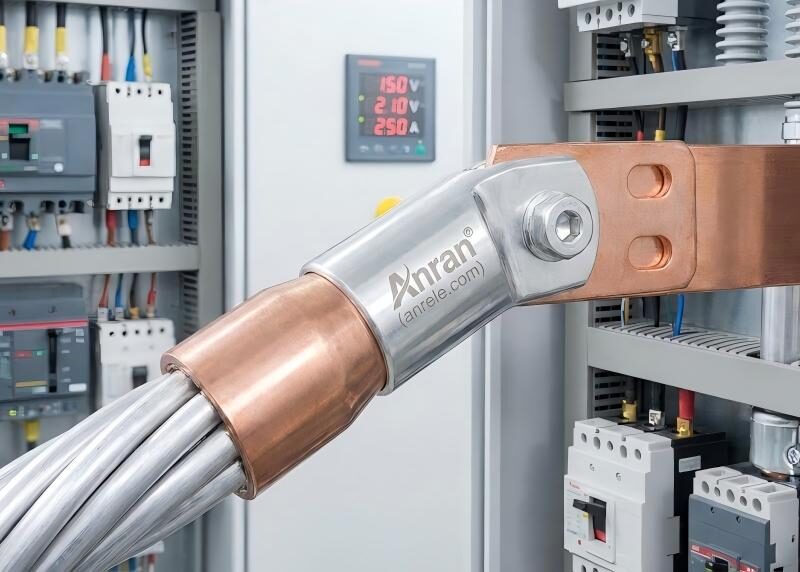
Introduction: The Hidden Threat in Power Distribution
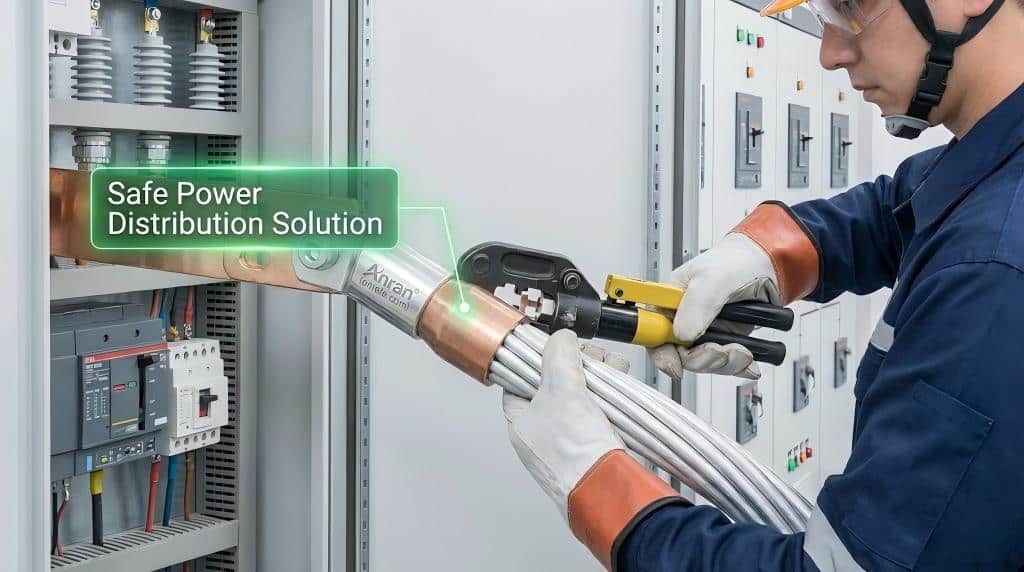
The global industrial power grid faces a relentless, invisible enemy: galvanic corrosion. To permanently eliminate this severe risk, specifying a precision-engineered bimetallic aluminum terminal connector is an absolute structural necessity. When electrical engineers connect massive aluminum power cables directly to copper busbars without the proper metallurgical interface, they inadvertently create a highly volatile chemical reaction. Because aluminum and copper possess vastly different electrochemical potentials, bringing them into direct physical contact in the presence of atmospheric moisture initiates a rapid galvanic degradation process.
Over time, this metallurgical incompatibility attacks the aluminum conductor, dramatically increasing the electrical resistance at the joint. Eventually, this localized resistance generates extreme thermal energy. As the connection overheats, it melts surrounding wire insulation, destroys expensive switchgear components, and frequently triggers catastrophic electrical fires. Furthermore, simple mechanical fixes—such as inserting a steel washer between the metals—fail completely under the immense stress of industrial high-voltage thermal cycling.
Therefore, modern electrical infrastructure strictly prohibits direct copper-to-aluminum mechanical connections. By deploying an advanced copper to aluminum connector, facility managers bridge this dangerous metallurgical gap. These specialized connectors fuse a solid aluminum barrel with a solid copper palm at the molecular level. In this comprehensive technical guide, we will analyze the precise physics of galvanic corrosion, explore the fascinating mechanics of solid-state friction welding, and demonstrate why utilizing these high-performance terminals is mandatory for safeguarding modern power distribution networks.
Core Advantages & The Physics of Electromechanics
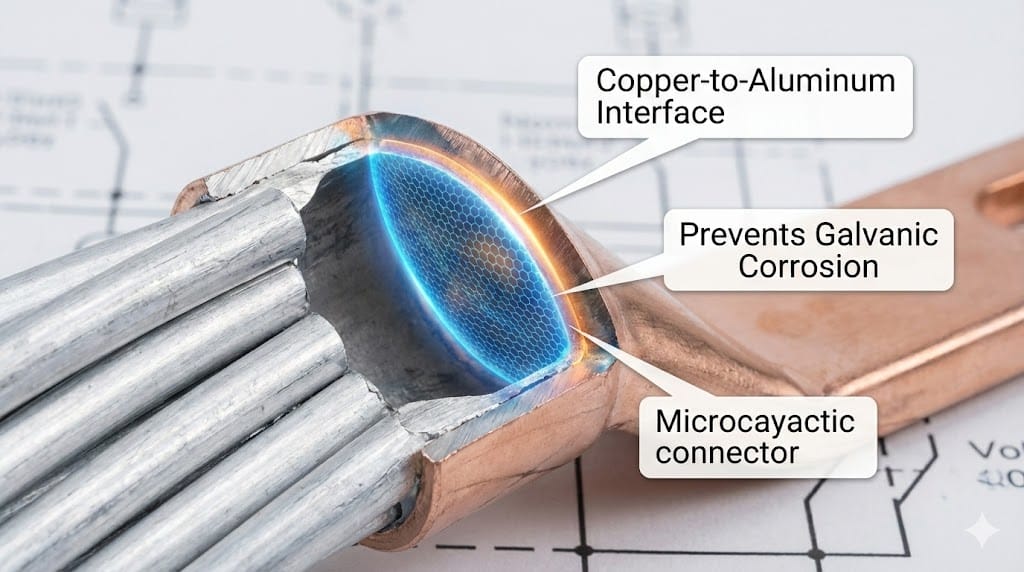
To truly understand why the electrical industry relies on bimetallic technology, we must examine the specific atomic physics and thermodynamic properties of the metals involved. A high-performance terminal must simultaneously facilitate flawless electron transfer and resist severe mechanical stress.
The Physics of the Galvanic Series
Galvanic corrosion occurs when two dissimilar metals connect electrically in the presence of an electrolyte (such as ambient humidity). In the galvanic series, copper acts as a highly noble (cathodic) metal, while aluminum acts as a highly active (anodic) metal. When they touch, the aluminum sacrifices its electrons to the copper, causing the aluminum to rapidly oxidize and physically disintegrate. A high-quality bimetallic aluminum terminal connector completely neutralizes this threat. Manufacturers create these terminals using pure electrolytic copper (for the mounting palm) and an advanced 6000-series or 1000-series aluminum alloy (for the cable barrel). Because the factory physically welds these two metals together in a controlled, oxygen-free environment, no electrolyte can ever penetrate the joint. Consequently, the galvanic reaction simply cannot occur, guaranteeing a lifetime of zero-resistance power transmission.
Solid-State Friction Welding Mechanics
Standard arc welding cannot join copper to aluminum; the extreme heat creates brittle, highly resistive intermetallic compounds that shatter under stress. Instead, manufacturers utilize an advanced process called solid-state friction welding. During manufacturing, high-powered CNC lathes spin the aluminum barrel against the stationary copper palm at several thousand revolutions per minute. This extreme friction generates highly localized, intense heat, plasticizing the metals without actually melting them into a liquid pool. Instantly, hydraulic rams forge the two glowing metals together under immense pressure. This mechanical forging action expels any surface oxides and creates a flawless, molecular-level bond. The resulting friction weld possesses a higher tensile strength than the parent aluminum itself.
Combating Thermal Creep
Beyond corrosion, engineers must mitigate ‘thermal creep.’ When high electrical currents pass through a metal, it heats up and expands. When the current drops, it cools and contracts. Aluminum possesses a thermal expansion coefficient significantly higher than copper or steel. If an installer bolts a pure copper lug onto an aluminum cable, the daily thermal cycling causes the aluminum to expand against the rigid copper, permanently deforming the aluminum wire (creep). Eventually, the connection becomes loose, leading to dangerous electrical arcing. By utilizing electrical distribution hardware featuring an aluminum barrel, the terminal expands and contracts at the exact same geometric rate as the aluminum cable trapped inside it. This thermodynamic synchronization guarantees that the heavy-duty hexagonal crimp remains permanently tight, entirely eliminating the risk of thermal creep failure.
Key Applications in Modern Industry
The profound safety benefits and efficiency of bimetallic technology mean these connectors serve as the backbone of high-stakes industrial power grids. Engineers specify these customized components wherever catastrophic power failure equates to unacceptable safety risks or massive financial losses.
Renewable Energy: Wind and Solar Infrastructure
Utility-scale solar farms and massive offshore wind turbines generate immense amounts of direct current (DC) and alternating current (AC) power. To transport this power over long distances to the central substations, engineers overwhelmingly specify heavy-gauge aluminum cables because they cost significantly less and weigh a fraction of equivalent copper cables. However, the internal contactors within the expensive solar inverters and step-up transformers consist exclusively of pure copper plates. Consequently, developers must utilize massive industrial wire terminals to transition the power from the aluminum transmission lines into the copper inverter inputs safely. The bimetallic lug serves as the vital, secure bridge in this multi-million-dollar renewable energy chain.
Electric Vehicle (EV) Charging Networks
The rapid expansion of Level 3 DC Fast Charging infrastructure demands robust power delivery systems. High-speed EV chargers draw massive amperage from the municipal grid. To handle this current without overheating, contractors run thick aluminum feeder cables from the street-level transformers directly to the charging pedestals. Moreover, because EV chargers operate in harsh, outdoor environments with extreme temperature fluctuations and high humidity, the risk of galvanic corrosion is exceptionally high. Therefore, specifying bimetallic high-voltage aluminum lugs ensures that these critical public charging stations remain operational, safe, and immune to environmental degradation.
Industrial Switchgears and Motor Control Centers
Inside heavy manufacturing facilities, Motor Control Centers (MCC) govern the operation of massive robotic assembly lines and industrial pumps. These switchgears feature incredibly tight spatial constraints. Engineers run flexible aluminum cables through complex conduit bends to reach the copper busbars inside the MCC. By applying a specialized bimetallic connector, technicians ensure a flawless, low-resistance connection that fits perfectly within the narrow phase-to-phase clearances required by strict industrial electrical codes.
Comparison Table: Analyzing Terminal Materials
When designing galvanic corrosion prevention architecture, electrical engineers must objectively evaluate various terminal substrates. The following table contrasts Bimetallic Lugs against pure Copper and pure Aluminum lugs across critical electrical performance metrics.
| Performance Metric | Bimetallic (Al/Cu) Terminal | Pure Copper Terminal | Pure Aluminum Terminal |
| Galvanic Corrosion Risk | Zero (Safely bridges Al to Cu) | Extreme (When paired with Al cable) | Extreme (When bolted to Cu busbar) |
| Thermal Expansion Match | Perfect (Al barrel matches Al cable) | Poor (Crushes Al cables over time) | Poor (Loosens when bolted to Cu) |
| Electrical Conductivity | Exceptional (Molecular bond) | Maximum (Industry baseline) | High (Vulnerable to oxide layers) |
| Mechanical Tensile Strength | Very High (Friction weld resists breaking) | Extremely High | Moderate (Prone to shearing) |
| Application Versatility | Universal (Connects any Al to Cu gear) | Limited (Copper-to-Copper only) | Limited (Aluminum-to-Aluminum only) |
As the electromechanical data clearly demonstrates, while pure copper offers maximum raw conductivity, utilizing it on an aluminum cable guarantees eventual mechanical and chemical failure. Conversely, the bimetallic terminal achieves the exact balance of thermodynamic compatibility and corrosion immunity required for the vast majority of modern, mixed-metal power distribution networks.
Customization and CNC Machining Capabilities
Procuring generic electrical lugs often leads to dangerous installation compromises. Switchgears and transformers possess highly specific stud sizes and phase-spacing requirements. Partnering with a comprehensive industrial manufacturer like Anran Electric guarantees that your electrical components match your exact engineering parameters flawlessly.
Precision CNC Drilling and Palm Customization
The copper palm of the terminal must bolt perfectly flat against the busbar to ensure maximum surface area contact. If the bolt hole is too large, the connection shifts; if the palm is warped, micro-arcing occurs. Anran Electric utilizes state-of-the-art multi-axis CNC machining centers to process the copper palms. We precision-drill the mounting holes to exact tolerances (M8, M10, M12, etc.) and face-mill the contact surface to guarantee absolute flatness. This meticulous CNC processing ensures a zero-resistance electrical interface.
Internal Jointing Compound Application
Aluminum instantaneously forms a non-conductive oxide layer when exposed to air. When an electrician inserts the stripped aluminum cable into the terminal barrel, this invisible oxide layer can hinder electron flow. To solve this, Anran factory-fills every bimetallic barrel with a specialized, highly conductive jointing compound (dielectric grease impregnated with sharp zinc particles). Furthermore, we cap the barrel with a plastic seal. When the installer crimps the barrel, the sharp zinc particles pierce the oxide layer on the cable strands, ensuring a flawless, cold-welded electrical connection.
Strict Friction Welding Quality Control
Because the friction weld carries the entire electrical and mechanical load, structural integrity is paramount. Anran subjects our bimetallic connectors to rigorous destructive and non-destructive testing. We utilize ultrasonic testing to verify that no microscopic voids exist within the solid-state weld. Additionally, we perform extreme tensile pull-tests to guarantee that the aluminum barrel will physically tear before the bimetallic weld ever fails. This strict quality assurance protocol guarantees absolute safety for your high-voltage infrastructure.
FAQ: 6 Highly Specific Questions Answered
1. What specific tooling is required to install these bimetallic connectors?
Installers must use a heavy-duty hydraulic crimping tool equipped with precisely sized hexagonal crimping dies. The hexagonal crimp applies uniform, 360-degree pressure, compressing the aluminum barrel and the internal cable strands into a nearly solid block of metal, thereby eliminating any microscopic air voids that could cause internal arcing.
2. Can these connectors safely manage medium and high-voltage applications?
Yes. Precision-manufactured bimetallic lugs are engineered to safely handle low-voltage (up to 1,000V), medium-voltage (up to 33kV), and highly specific high-voltage applications. However, for applications exceeding 11kV, contractors must ensure the external profile of the lug is perfectly smooth to prevent electrical corona discharge, and they must apply appropriate high-voltage heat shrink tubing.
3. Why is there a plastic cap on the end of the aluminum barrel?
The plastic cap serves a vital purpose: it seals the factory-applied conductive jointing compound (dielectric grease) inside the barrel, preventing it from drying out or becoming contaminated by job site dust and moisture prior to installation. Installers simply pop the cap off immediately before inserting the stripped aluminum cable.
4. Can I use a bimetallic lug to connect a copper cable to an aluminum busbar?
Yes, but you must specify a reverse-bimetallic lug. Standard bimetallic lugs feature an aluminum barrel (for Al cable) and a copper palm (for Cu busbars). If your architecture is reversed, we can manufacture custom lugs featuring a copper barrel to accept your copper cable, fused to an aluminum palm that bolts safely to your aluminum equipment.
5. How does the friction weld handle the mechanical stress of heavy cable vibration?
Solid-state friction welding creates a metallurgical bond where the copper and aluminum atoms intermingle. It is not a surface-level adhesive or solder. Consequently, the weld joint easily withstands severe, continuous mechanical vibration (such as those found in wind turbine nacelles or heavy railway locomotives) without suffering metal fatigue or stress fracturing.
6. What is the typical production lead time for custom palm dimensions?
For specific switchgear requirements where standard palm widths or customized multi-hole drill patterns are necessary, our CNC department moves rapidly. Upon approval of the engineering drawings, we typically manufacture, friction-weld, CNC-machine, and prepare large-scale commercial orders for international shipping within 15 to 20 business days.
Conclusion: Securing Your Electrical Infrastructure
Ultimately, the safety, efficiency, and longevity of your power distribution network depend entirely on the integrity of its weakest connections. By leveraging the advanced metallurgical properties of solid-state friction welding, electrical engineers effectively eliminate the catastrophic threats of galvanic corrosion and thermal creep.
Do not allow inferior, mismatched hardware to bottleneck the performance or jeopardize the safety of your industrial facility. Transition to precisely engineered, CNC-machined electrical interfaces designed specifically to protect your high-voltage assets. Explore our comprehensive manufacturing capabilities and collaborate with our electromechanical engineering team by visiting our Aluminum Terminal Connector product catalog today.