

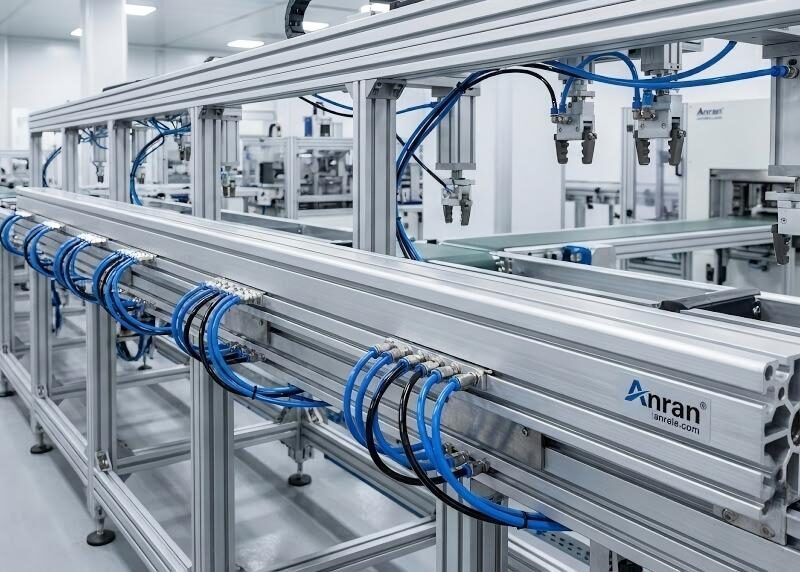
Introduction: Eradicating Inefficiency in Fluid Power Routing
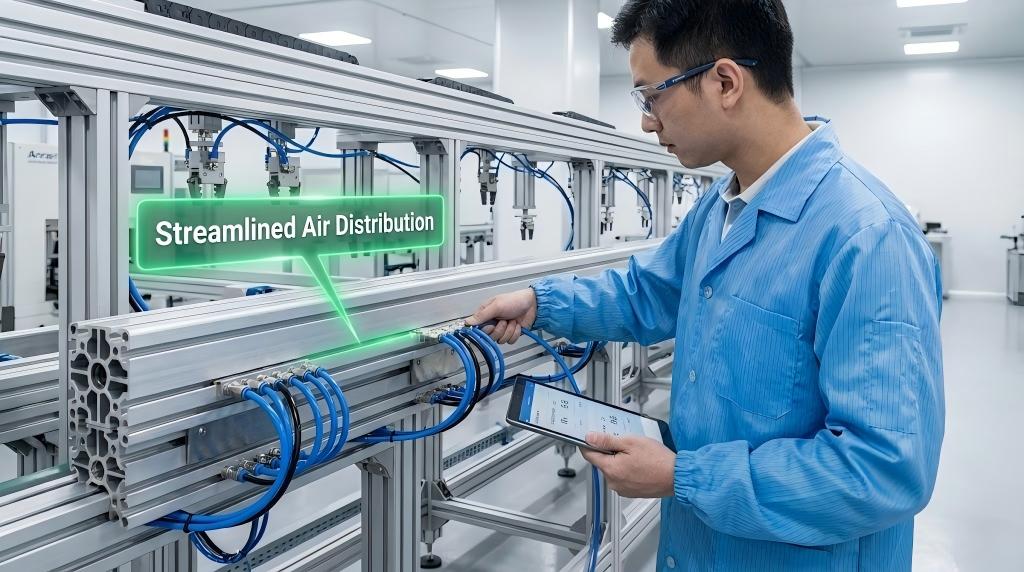
In the realm of modern manufacturing, compressed air operates as the critical “fourth utility,” driving everything from delicate robotic grippers to massive stamping presses. However, generating compressed air is notoriously expensive and thermodynamically inefficient. When engineers design chaotic, decentralized pneumatic routing networks using individual T-fittings, cross-connectors, and sprawling polyurethane hoses, they inadvertently introduce massive pressure drops and dozens of potential leak points. Consequently, specifying a centralized aluminum pneumatic busbar is the most effective structural intervention an engineer can execute to optimize factory air consumption.
A pneumatic busbar operates identically to an electrical busbar: it receives a single, high-volume input of pressurized energy and distributes it flawlessly to multiple output stations. By replacing a tangled “spaghetti network” of hoses with a single, rigid, precision-machined header, facility managers instantly eliminate the turbulent airflow and frictional losses associated with standard plumbing fittings. Furthermore, consolidating multiple solenoid valves onto a single block drastically reduces the physical footprint of the control cabinet.
Therefore, upgrading to a professionally engineered multi-station air manifold is a mandatory step for facilities seeking to lower their energy expenditures and improve machine cycle times. In this comprehensive technical guide, we will dissect the fluid dynamics of compressed air routing, analyze the specific metallurgical advantages of extruded aluminum over legacy steel headers, and explore how precision CNC manufacturing guarantees leak-free performance in high-stakes automated environments.
Core Advantages & The Physics of Fluid Mechanics
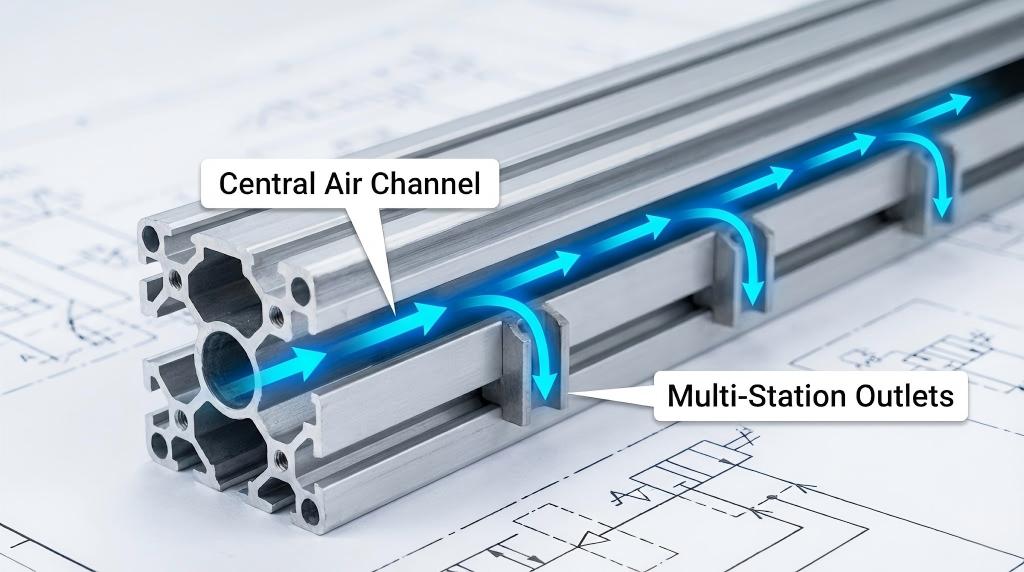
To truly understand why the automation industry has universally abandoned heavy steel pipes in favor of extruded aluminum headers, we must examine the fundamental physics of fluid dynamics and material science. A distribution block must safely contain pressurized gas while facilitating high-velocity airflow with minimal frictional resistance.
Fluid Dynamics and Laminar Flow Optimization
Inside a pneumatic circuit, air velocity and pressure drop dictate the actuation speed of the attached cylinders. When compressed air forces its way through standard brass T-fittings or sharp 90-degree elbows, it generates severe turbulence. According to the Darcy-Weisbach equation, this turbulence drastically increases the friction factor, resulting in a measurable drop in pressure downstream. An extruded pneumatic distribution block entirely circumvents this thermodynamic penalty. Because the main internal gallery is formed through seamless aluminum extrusion rather than cross-drilling, the internal walls possess an exceptionally smooth surface finish. This smooth bore promotes a laminar flow regime. The air travels uniformly down the central header and feeds the individual output ports without generating chaotic eddies or kinetic energy loss. Ultimately, the valves receive consistent, high-pressure air, allowing the machine to cycle faster and more predictably.
The Metallurgy of 6063-T5 Extrusions
Manufacturers cannot utilize cast iron or standard plastics for high-volume air distribution due to porosity and burst risks. Instead, industry leaders like Anran Electric utilize advanced 6063-T5 aluminum alloys. Engineers specifically specify the 6063 alloy because its precise magnesium and silicon alloying elements allow it to flow perfectly through complex extrusion dies. The resulting profile is completely solid and homogenous, featuring zero internal porosity or casting voids where high-pressure air could slowly escape. Following extrusion, the ‘T5’ artificial aging process increases the material’s yield strength, allowing the lightweight air headers to easily withstand continuous industrial air pressures of up to 15 Bar (217 PSI) with a massive factor of safety against catastrophic rupture.
Absolute Immunity to Internal Oxidation
Compressing ambient air inherently concentrates atmospheric humidity. Even with industrial refrigerated air dryers, microscopic moisture vapor inevitably enters the pneumatic circuit. If a facility utilizes carbon steel or black iron pipes for its distribution headers, this moisture quickly causes internal oxidation (rust). Over time, the high-velocity air strips these microscopic rust flakes away and blows them directly into the sensitive spools of proportional valves, causing immediate mechanical jams. Conversely, aluminum forms a permanent, self-healing layer of aluminum oxide the moment it contacts oxygen. This passivation layer makes the busbar completely immune to rust. Consequently, the air exiting the manifold remains surgically clean, protecting the downstream automation components and eliminating unexpected machine downtime.
Key Applications in Modern Industry
The profound geometric versatility and low physical mass of these distribution blocks mean they operate at the core of highly demanding industrial sectors. Engineers specify these customized components wherever space constraint, weight reduction, and extreme reliability dictate mission success.
Industrial Factory Automation and Packaging
In the consumer goods and packaging sectors, high-speed machines utilize dozens of pneumatic cylinders to fold, push, and seal cartons. Routing individual air lines from the main compressor to every single cylinder creates an unmanageable maintenance nightmare. Therefore, designers utilize long, industrial factory automation busbars mounted directly to the machine chassis. Installers mount banks of solenoid directional control valves directly onto these blocks. This architecture consolidates the electrical wiring and the pneumatic plumbing into one highly organized, easily accessible control node.
Robotic End-of-Arm Tooling (EOAT)
Modern six-axis industrial robots frequently utilize complex pneumatic grippers or vacuum suction cups on their End-of-Arm Tooling (EOAT) to manipulate heavy payloads. Every gram of weight added to the end of a robotic arm exponentially increases the inertial stress on the robot’s servo motors. Moreover, heavy tooling forces programmers to reduce the overall velocity of the robot to maintain accuracy. By integrating a heavily CNC-machined, miniaturized compressed air systems manifold made from lightweight aluminum, engineers slash the dead payload weight. Consequently, the robot accelerates faster, settles into position quicker, and consumes significantly less electrical power.
Cleanroom and Semiconductor Manufacturing
The manufacturing of silicon wafers requires ISO Class 1 to Class 5 cleanroom environments. Equipment operating inside these rooms must not outgas chemicals or shed any particulate matter. Traditional steel pipes are strictly banned due to rust potential, and standard plastics are often banned due to static electricity generation and chemical outgassing. Anodized aluminum busbars represent the perfect electromechanical solution. They are non-shedding, completely inorganic, and electrically conductive enough to be easily grounded, preventing hazardous static buildup in highly sensitive semiconductor environments.
Comparison Table: Analyzing Distribution Substrates
When designing fluid power distribution architecture, structural engineers must objectively evaluate various material substrates. The following table contrasts extruded 6063-T5 aluminum against traditional steel, copper, and engineering plastics across critical pneumatic performance metrics.
| Performance Metric | Extruded Aluminum (6063-T5) | Carbon / Black Steel | Copper / Brass Alloys | Engineered Plastics (POM) |
| Weight-to-Strength Ratio | Exceptional (Ultra-light, high strength) | Poor (Extremely heavy) | Moderate (Heavy) | Excellent (Light, low strength) |
| Internal Contamination | Zero (Immune to rust/oxidation) | Extreme (Rusts from condensate) | Low (Tarnishes, rarely flakes) | Zero (Immune to oxidation) |
| Internal Flow Resistance | Very Low (Smooth extruded bore) | High (Rough casting/seams) | Very Low (Smooth drawn bore) | Low (Smooth molded bore) |
| Machinability for Custom Ports | Excellent (Fast CNC drilling/tapping) | Poor (High tool wear) | Excellent (Fast machining) | Moderate (Threads strip easily) |
| Material Cost at Scale | Highly Cost-Effective | Inexpensive | Extremely Expensive | Inexpensive |
As the mechanical data explicitly demonstrates, while plastics offer lightweight properties, their threaded ports frequently strip or crack when subjected to the repeated shock-loading of pneumatic valve shifting. Steel is simply too heavy and prone to catastrophic rust. Ultimately, aluminum achieves the exact combination of threaded port durability, absolute weight reduction, and contamination-free operation required for elite factory infrastructure.
Customization and CNC Machining Capabilities
Procuring a raw aluminum extrusion is merely the first step in creating a functional fluid power header. Transforming that extrusion into a precision distribution block requires executing highly exact CNC machining protocols. Partnering with a comprehensive industrial manufacturer like Anran Electric guarantees flawless internal geometry and absolutely leak-free porting.
CNC Drilling and Pitch Precision
To mount modular solenoid valves (such as those adhering to ISO 5599 or NAMUR standards), the output ports on the busbar must be spaced with absolute micro-precision. If the port pitch distance is off by a fraction of a millimeter, the rigid valve manifolds will not align, rendering the entire block useless. Anran utilizes state-of-the-art multi-axis CNC machining centers to drill the output galleries. We guarantee exact pitch spacing across the entire length of the busbar, accommodating configurations from 2 stations all the way up to 20+ stations seamlessly.
Threading Standards and Tolerance Control
A pneumatic system is only as secure as its threaded connections. When CNC tapping the inlet and outlet ports, we strictly adhere to international threading standards. Whether your facility utilizes NPT (National Pipe Tapered) for North American markets, or BSPP (G-Threads) for European and Asian markets, our CNC tools cut razor-sharp, exact threads. We continuously gauge our threads during production to ensure maximum engagement with your pneumatic fittings, permanently eliminating the risk of micro-leaks or blown-out connectors.
Surface Finishing to Prevent Thread Galling
Aluminum possesses a known tribological vulnerability: ‘galling.’ When two raw aluminum surfaces rub together under pressure (such as screwing an aluminum fitting into an aluminum block), the metals can cold-weld and seize. To prevent this, Anran Electric offers advanced surface treatments, including Type II sulfuric acid anodizing and Type III hardcoat anodizing. This electrochemical process transforms the surface of the threads into a hard ceramic oxide, drastically reducing friction, preventing galling, and allowing technicians to safely thread and unthread fittings for decades without stripping the block.
FAQ: 6 Highly Specific Questions Answered
1. What is the maximum safe operating pressure for these aluminum busbars?
Standard industrial compressed air systems operate between 6 to 8 Bar (87 to 116 PSI). Our 6063-T5 extruded aluminum busbars are engineered to safely handle sustained working pressures up to 15 to 20 Bar (217 to 290 PSI). They feature a massive burst-pressure safety factor, ensuring absolute workplace safety under continuous shock-loading.
2. Which thread types can Anran machine into the distribution blocks?
We utilize advanced CNC tapping centers capable of cutting any global thread standard. We routinely supply blocks with NPT (National Pipe Tapered), BSPP (British Standard Pipe Parallel / G-Thread), BSPT (R-Thread), and Metric (M-Thread) ports to ensure 100% compatibility with your existing pneumatic push-to-connect fittings.
3. Can you manufacture custom station counts, or are we limited to standard sizes?
Because we control the entire extrusion and CNC machining process in-house, we are not limited to standard catalog sizes. We can CNC machine continuous busbars featuring anywhere from 2 stations up to 24+ stations on a single monolithic block, tailoring the component exactly to the spatial constraints of your machine design.
4. How do you prevent thread galling when installing fittings into the aluminum block?
To mitigate aluminum galling, we highly recommend our factory anodizing service, which hardens the thread surfaces. Furthermore, installers should always utilize a high-quality PTFE (Teflon) thread-sealing tape or a specialized anaerobic liquid pipe sealant. This provides vital lubrication during installation while simultaneously sealing the joint against high-pressure air leaks.
5. Are your busbars compatible with standard ISO or NAMUR valve mounting patterns?
Yes. Our engineering department regularly machines mounting interfaces that strictly comply with international fluid power standards, including ISO 5599-1 sizes and NAMUR interface patterns. This allows you to directly bolt standard valves from manufacturers like Festo, SMC, MAC, and Parker directly to our manifolds without modification.
6. What is the typical lead time for a custom-machined distribution manifold?
If you select an existing extrusion profile from our catalog and only require custom CNC drilling/tapping, we can typically deliver prototype units within 7 to 10 days. If your project requires a completely bespoke external extrusion geometry (such as unique mounting flanges or integrated T-slots), custom die creation and initial sampling will take approximately 15 to 20 business days.
Conclusion: Consolidating Your Automation Architecture
Ultimately, the efficiency, aesthetic organization, and reliability of your automated machinery depend entirely on the logical routing of its pneumatic power. By leveraging the internal smoothness, extreme strength-to-weight ratio, and custom geometric versatility of advanced aluminum extrusions, engineers effectively eliminate the liabilities of disorganized, leak-prone plumbing.
Do not allow chaotic tubing and turbulent airflow to bottleneck the cycle times of your production facility. Transition to precisely engineered, CNC-machined components designed specifically to streamline your compressed air architecture. Explore our comprehensive manufacturing capabilities and collaborate with our fluid power engineering team by visiting our Aluminum Pneumatic Busbar product catalog today.