Introduction: The Critical Link in a 25-Year Asset
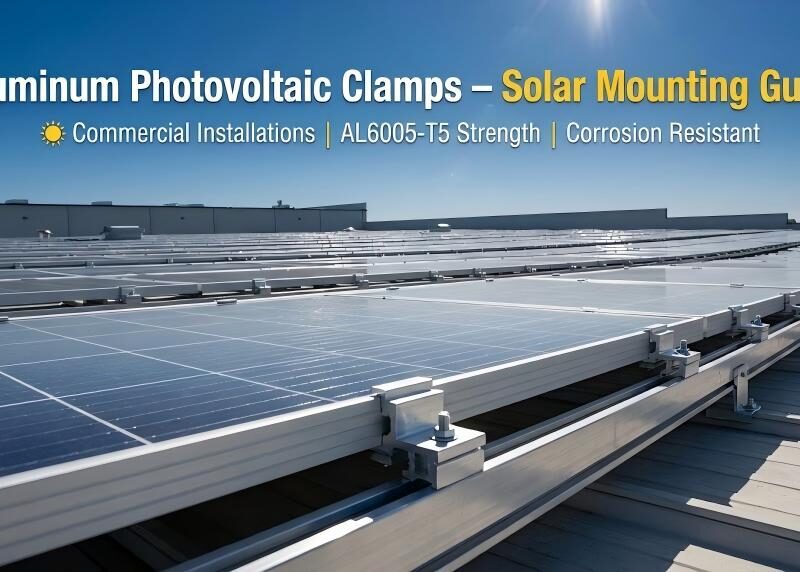
A commercial solar installation is a long-term financial asset, designed to generate revenue for 25 years or more. While much attention is paid to the efficiency of the photovoltaic (PV) panels and the reliability of the inverters, the mechanical mounting system is often treated as an afterthought. This is a critical error. The mounting clamp is the single point of failure that holds expensive glass panels against hurricane-force winds, snow loads, and thermal expansion cycles. The aluminum photovoltaic clamp is not just a fastener; it is your primary insurance policy against catastrophic system failure.
In the early days of solar, installers often used generic framing materials or heavy galvanized steel. Today, the industry has standardized on engineered aluminum systems due to their superior strength-to-weight ratio and natural corrosion resistance. However, not all aluminum clamps are created equal. The difference between a budget clamp and an engineered structural component lies in the alloy selection (AL6005 vs AL6063), the anodizing quality, and the geometric design.
This guide explores the technical specifications of Anrele’s solar mounting hardware. We will examine why we use high-strength AL6005-T5, how to calculate wind uplift safety factors, and how to ensure your mounting system outlasts the panels it supports. For custom rail profiles, visit our Aluminum Profiles page.
Types of Aluminum Photovoltaic Clamps: End-Clamps vs. Mid-Clamps
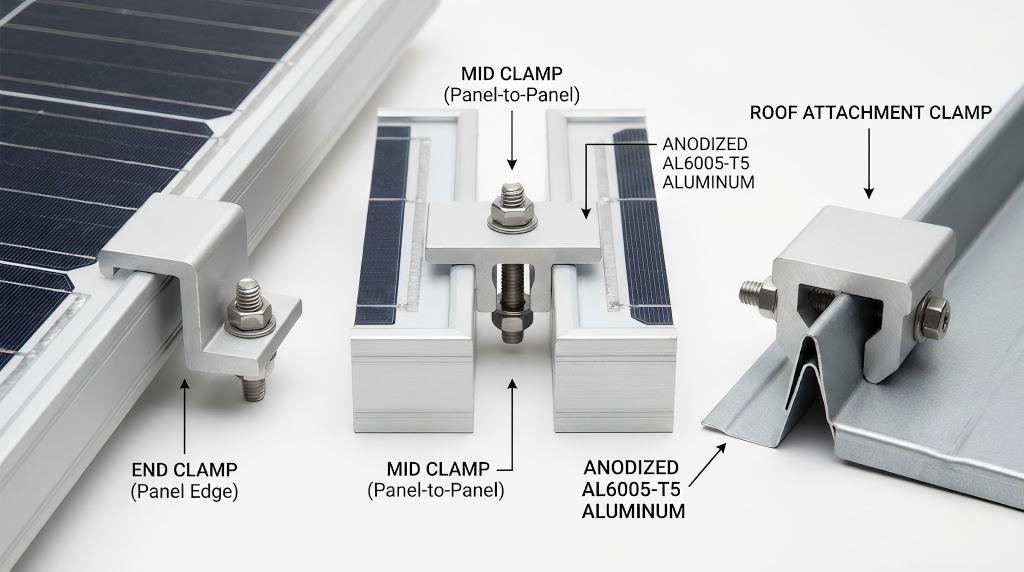
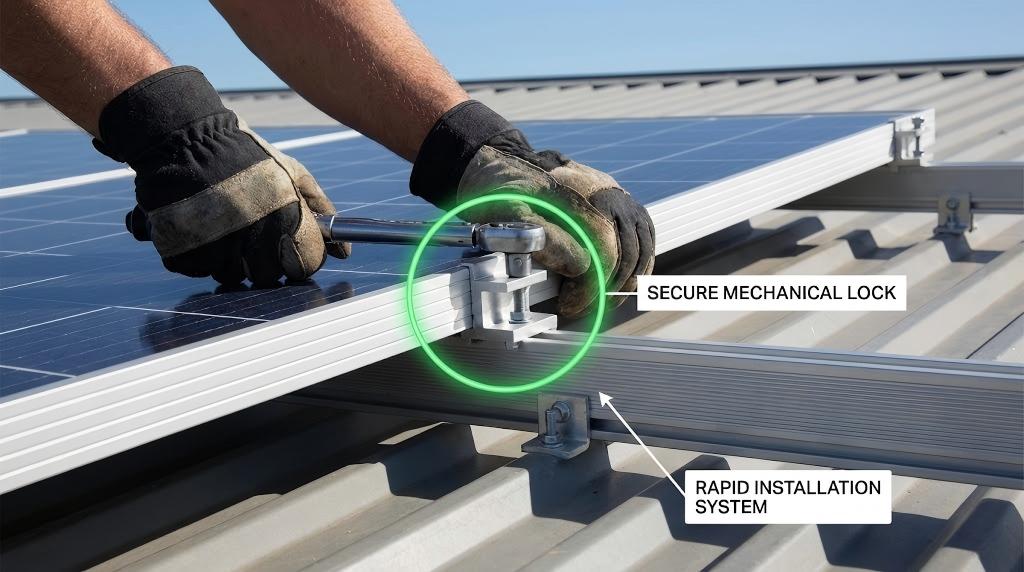
A standard rail-based mounting system relies on two distinct clamp geometries. Understanding their mechanical function is key to a secure install.
The Mid-Clamp (Inter-Module Clamp)
The mid-clamp creates a T-shaped friction grip between two adjacent solar panels. It must withstand sheer forces from two directions. Anrele mid-clamps feature integrated grounding pins (bonding clips) that pierce the anodized coating of the panel frame, creating a continuous electrical path for safety grounding. This eliminates the need to run separate ground wires between every panel.
The End-Clamp (Z-Module Clamp)
The end-clamp secures the last panel in a row to the rail. Unlike the mid-clamp, it is unsupported on one side. This makes it susceptible to rotation if over-torqued. Our end-clamps are designed with a stiffening rib and a variable-height adjustment to securely grip panel frames ranging from 30mm to 40mm thick without twisting.
Material Focus: Why AL6005-T5 is Stronger than Standard 6063
Most architectural aluminum (like window frames) is made from 6063-T5 alloy. While 6063 is easy to extrude, it lacks the tensile strength required for structural roof mounting in high-wind zones. Anrele exclusively uses AL6005-T5 for all solar clamps.
The Metallurgical Difference
• AL6063-T5 Yield Strength: ~145 MPa
• AL6005-T5 Yield Strength: ~225 MPa
By switching to AL6005, we achieve a **55% increase in structural strength**. This allows our clamps to withstand higher torque settings during installation and resist deformation under heavy snow loads. Learn more about our material standards on our About Us page.
Material and Corrosion Resistance Requirements (Anodizing >10μm)
Solar arrays are installed in some of the harshest environments on earth, from salt-sprayed coastal roofs to acidic industrial zones. Raw aluminum will eventually pit and degrade.
Anodizing for Longevity
We specify a clear anodized coating thickness of **≥10 microns (µm)** for all solar hardware. This electrochemical layer is harder than glass and seals the aluminum against oxidation. For projects in extreme marine environments (C5 corrosion zones), we offer custom anodizing services up to 20-25 microns.
Galvanic Corrosion Prevention
When aluminum clamps touch stainless steel bolts or copper wires, galvanic corrosion can occur. We use 304 Stainless Steel bolts with a specialized Dacromet coating to prevent seizing and separate the electrical potential of the dissimilar metals.
Load, Wind, and Weather Considerations for Rooftop Safety
The clamp is the connection point that transfers all environmental forces from the large surface area of the panel into the building structure.
Calculating Uplift
Wind blowing over a slanted roof creates a low-pressure zone (suction) that tries to rip the panels off the roof. This is known as ‘Wind Uplift.’ Anrele clamps are tested to withstand wind speeds of up to **60 m/s (134 mph)**. However, the installer must ensure the rail spacing complies with local building codes.
Thermal Expansion
A 20-meter row of aluminum rails can expand by several centimeters on a hot day. The clamps must allow for this movement without loosening. Our designs include spring-loaded washers (Belleville washers) that maintain constant tension even as the metal expands and contracts. For related electrical connections, see our Aluminum Terminal Connectors.
Compatibility with Mounting Rails and Frameless Panels
Versatility is key for installers who encounter different roof types.
Universal Rail Interface
Our clamps use a standard sliding nut designed to fit the top channel of most commercial solar rails (including Anrele, Unirac, and IronRidge profiles). This allows distributors to stock one type of clamp for multiple rail brands.
Frameless (Thin Film) Solutions
Glass-on-glass solar modules do not have an aluminum frame. Standard clamps would crush the glass. For these panels, we offer specialized clamps with EPDM rubber inserts that grip the glass gently but firmly, distributing the holding force over a 100mm length.
Conclusion: Securing Solar Assets for 25 Years
In the equation of a solar investment, the mounting hardware represents less than 5% of the total cost, yet it is responsible for 100% of the structural security. Choosing cheap, low-grade clamps is a false economy that risks panel loss and roof damage.
Anrele’s AL6005-T5 clamps provide the engineering certainty required for commercial projects. Whether you are mounting on a warehouse metal roof or a ground mount system, our hardware is built to outlast the PPA. Contact our engineering team for a wind load calculation or sample kit.
FAQ: Common Technical Questions
1. What aluminum alloy is best for PV clamps?
AL6005-T5 is the superior choice. It offers significantly higher tensile and yield strength than the common 6063 alloy, providing better resistance to wind uplift and snow loads.
2. How long do aluminum solar clamps last outdoors?
With proper anodizing (>10µm), aluminum clamps are designed to last 25+ years, matching the standard warranty period of solar panels. They do not rust like galvanized steel.
3. Are these clamps compatible with metal standing seam roofs?
Yes, but you need a specific interface called a ‘Standing Seam Clamp’ (e.g., Klip-Lok type) that grips the roof seam without penetrating it. The PV clamp then attaches to this seam clamp or a mini-rail.
4. Do I need stainless steel grounding clips?
Most Anrele mid-clamps come with integrated grounding pins/teeth. These pierce the anodized coating of the panel frame to establish electrical continuity, often eliminating the need for separate grounding clips.
5. What torque setting is recommended for installation?
Standard torque is typically 15-20 Nm for M8 bolts, but this varies by bolt material and rail type. Always check the specific installation manual to avoid crushing the panel frame.
6. Can Anrele clamps withstand hurricane-force winds?
Yes, our heavy-duty clamps are tested for wind speeds up to 60 m/s. However, the entire system (rail, L-feet, and roof attachment) must be engineered together to certify the installation for hurricane zones.