

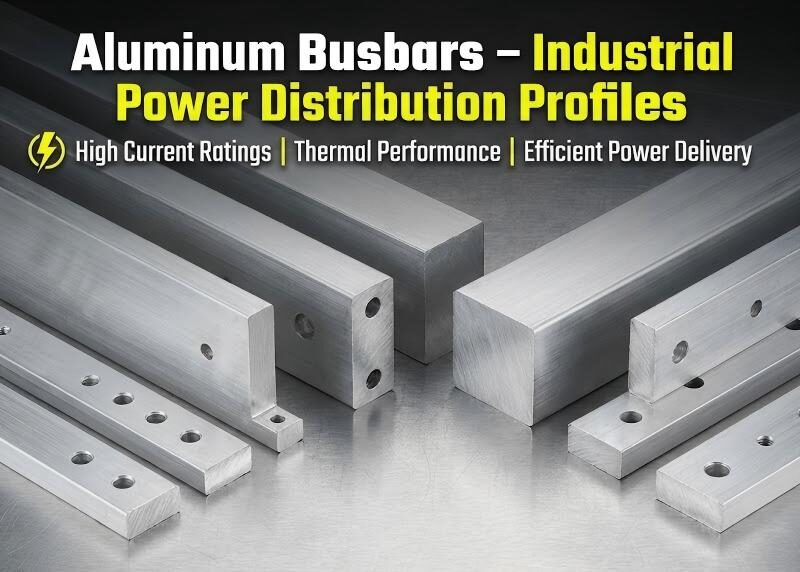
Introduction: The Backbone of High-Current Systems
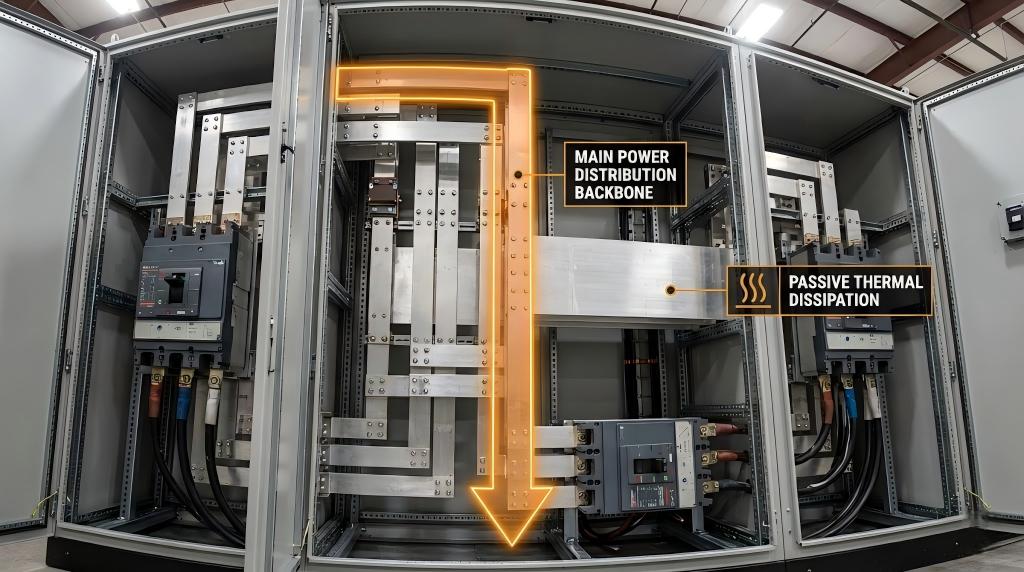
Inside every industrial switchgear cabinet, substation, or data center power room, there is a massive highway of energy. These rigid metallic strips, known as busbars, carry currents ranging from 100 Amps to 5000+ Amps. For over a century, copper was the default material. However, as global copper reserves tighten and prices skyrocket, the electrical industry has undergone a paradigm shift toward the aluminum busbar.
This transition is not a compromise; it is an optimization. Modern aluminum alloys (like 6101-T6), combined with advanced plating technologies, offer a conductivity-to-weight ratio that copper simply cannot match. From wind turbine nacelles to EV battery interconnects, aluminum is becoming the metal of choice for high-power distribution.
This guide provides a comprehensive technical analysis of aluminum busbar systems. We will compare ampacity ratings, discuss the ‘Skin Effect’ in AC systems, and explain why Anrele’s plating services are critical for long-term reliability. For custom profile inquiries, contact our engineering team.
Why Aluminum Busbar is Replacing Copper (Cost & Weight)
The engineering case for aluminum busbars rests on two pillars: Specific Conductivity and Economics.
The Conductivity-Density Ratio
Copper has a conductivity of 100% IACS. Aluminum (6101 grade) has a conductivity of ~57-61% IACS. At face value, copper wins. But copper density is 8.96 g/cm³, while aluminum is only 2.70 g/cm³.
This means that to carry the same current, an aluminum busbar needs to be roughly 1.5 times larger in cross-section than copper. However, even with this larger size, the aluminum busbar will weigh **50% less** than the equivalent copper bar. In applications like marine vessels or overhead trucking, this weight savings is critical.
Cost Stability
Copper prices are volatile. Aluminum prices are relatively stable and significantly lower. For a large switchgear project, switching to aluminum can reduce the busbar material cost by up to 70%.
Design Considerations: Cross-section vs. Current Ratings (Ampacity)
Designing with aluminum requires calculating the required cross-sectional area to handle the thermal load. This is often done using custom aluminum extrusion to create shapes that maximize surface area for cooling.
Ampacity Calculation
Ampacity is determined by the allowable temperature rise (usually 30°C or 65°C above ambient). Because aluminum has lower conductivity, it generates more resistive heating per mm². Therefore, we must increase the surface area to dissipate this heat.
The Skin Effect (AC Systems)
In Alternating Current (AC) systems, current tends to flow on the outer surface of the conductor (Skin Effect). A thick, solid rectangular bar is inefficient because the center carries little current. Anrele solves this by extruding hollow ‘Double-T’ or ‘Channel’ busbar profiles. These shapes provide high surface area for cooling and skin-effect efficiency while minimizing material usage.
Thermal and Safety Considerations (Heat Rise)
Safety in power distribution is non-negotiable. The busbar system must withstand short-circuit forces and thermal cycling.
Short Circuit Strength
During a fault, massive magnetic forces try to rip parallel busbars apart. Aluminum 6101-T6 has a yield strength of ~195 MPa, which is sufficient for most bracing requirements. However, the busbar supports must be spaced closer together compared to copper due to aluminum’s lower modulus of elasticity.
Thermal Expansion
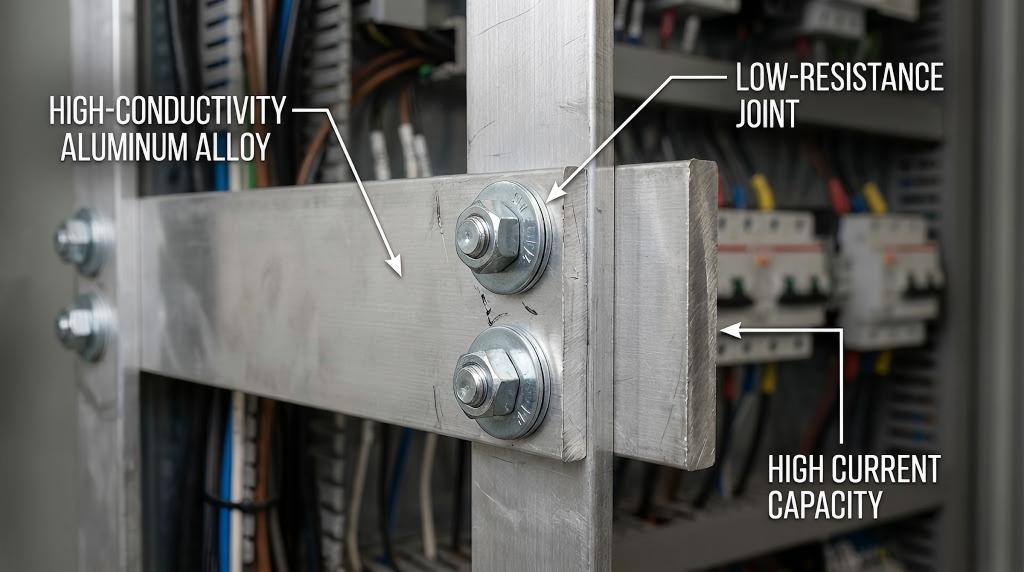
Aluminum expands more than copper when heated (Coefficient of Thermal Expansion: 23 vs 17 µm/m·K). Connections must be designed to accommodate this movement to prevent loosening. We recommend using Belleville washers and our flexible aluminum terminal connectors at expansion joints.
Surface Plating: Tin vs. Silver for Contact Efficiency
Aluminum quickly forms a non-conductive oxide layer. To ensure a low-resistance connection, plating is mandatory. Learn more about our finishing capabilities on our Service Page.solar components for related hardware.aluminum heat sinks.
Tin Plating
The industry standard. Tin is soft, conductive, and cost-effective. It prevents oxidation and is compatible with most copper lugs.
Silver Plating
Used for high-performance applications. Silver has the highest conductivity of any metal and its oxide is also conductive. However, it is susceptible to sulfuration (tarnishing) in polluted environments.
Integration into Panels and Equipment
Anrele provides not just raw bars, but fabricated busbar kits ready for assembly.
• Solar Power: Combining inverters in large PV arrays requires massive DC busbars. See our
• Thermal Management: In some designs, the busbar itself acts as a heat sink for attached IGBTs. We can integrate finned profiles similar to our
Conclusion: Powering the Future Efficiently
The myth that aluminum is ‘inferior’ to copper in power distribution has been debunked by decades of successful use in the utility sector. With proper alloy selection, profile design, and surface plating, aluminum busbars offer a reliable, lightweight, and cost-effective solution for modern electrification.
Anrele is your partner for high-current aluminum solutions. From extrusion to plating and bending, we handle the entire value chain. Request a Quote for your busbar project today.
Learn more about our manufacturing standards at About Anrele.
FAQ: Common Technical Questions
1. Can aluminum busbars replace copper directly?
Not dimensionally. You cannot swap a 50x10mm copper bar for a 50x10mm aluminum bar because the ampacity will be lower. You typically need to increase the aluminum bar size by ~50% to carry the same current.
2. How is heat managed in aluminum busbars?
Through surface area. We extrude aluminum bars with larger surface areas (or painted black to increase emissivity) to radiate heat more effectively. The permissible temperature rise limits (e.g., ANSI C37.20) must be respected.
3. What is the weight difference between Aluminum and Copper busbars?
For an equivalent ampacity rating, an aluminum busbar system weighs approximately 50% less than a copper system. This reduces the structural load on switchgear cabinets.
4. How do you prevent oxidation on aluminum busbar joints?
We recommend Tin or Silver plating on all contact surfaces. Additionally, applying a conductive joint compound (oxide inhibitor grease) during assembly helps seal the joint from oxygen and moisture.
5. What are the standard sizes for aluminum busbars?
Common sizes range from 20x3mm up to 200x20mm flat bars. However, Anrele specializes in custom extruded shapes (channels, tubes) to optimize performance.
6. Is tin plating necessary for aluminum busbars?
Highly recommended. While bare aluminum can be used with rigorous cleaning and grease, tin plating provides a stable, long-term low-resistance interface that requires less maintenance.