

Introduction

High-power electronic architecture faces severe thermal throttling risks constantly. Hardware engineers must extract intense kinetic heat to prevent catastrophic system degradation. You must secure a flawless thermal control strategy to protect your delicate silicon dies. Finding a highly verified aluminum heat sink manufacturer solves this critical mechanical bottleneck immediately. Modern solid-state processors, high-lumen LED arrays, and industrial motor drives generate massive thermodynamic loads. If your system fails to dissipate this concentrated thermal energy, the internal delicate components literally melt. This structural failure triggers immediate global product recalls and destroys valuable corporate brand equity overnight.
Many procurement officers underestimate the extreme complexity of metallurgy. They purchase basic, uncalibrated metal fins from unverified trading companies. These inferior components feature poor alloy purity and terrible microscopic surface flatness. A curved or warped base plate ruins the thermal contact area completely. It traps insulating microscopic air pockets between the heat sink base and the processor die. This tiny gap guarantees total thermal failure during peak megawatt operating loads.
You must migrate your component supply chain toward an elite Original Equipment Manufacturer (OEM). A specialized factory executes precise, sub-millimeter extrusion. They master fluid dynamics and advanced industrial metallurgy. This technical guide deconstructs the exact thermodynamics governing cooling fin geometry. We evaluate the specific aluminum alloys required to achieve maximum thermal conductivity. Finally, we detail how securing proper thermal dissipation profiles guarantees absolute temperature control for your electronic hardware.
Thermodynamics and Extrusion Fin Geometry
Thermal dynamics dictate electronic hardware performance absolutely. High power chips generate massive thermal loads. Engineers require precise cooling fin geometry. Heat sinks must absorb this thermal energy. They must dissipate it into the ambient air. We execute this transfer through rigorous engineering.
Calculating Thermal Resistance
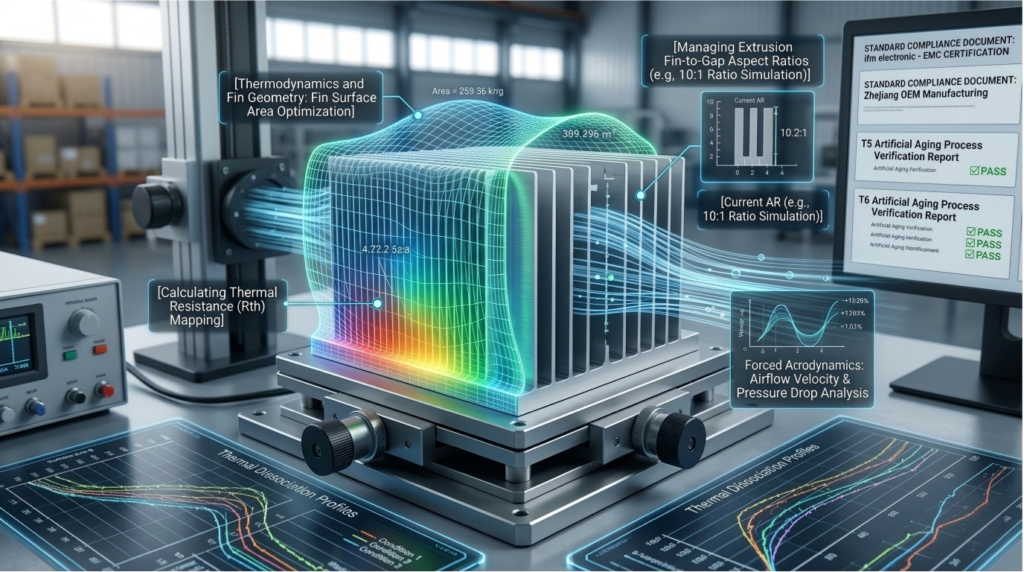
We calculate thermal resistance values rigorously. Thermal resistance measures heat transfer efficiency accurately. Lower resistance means vastly better cooling performance. The formula evaluates active surface area parameters. It also factors in specific material conductivity. Extruded fins maximize this available surface area. They pull heat away from the silicon base. We optimize the base plate thickness carefully. A thick base spreads heat evenly outward. A thin base creates dangerous local hotspots. Engineers balance these variables precisely.
Managing Extrusion Aspect Ratios
Aspect ratio defines fin height versus gap width. High ratios pack more fins together tightly. This maximizes the total cooling surface area. However, extreme ratios challenge the extrusion die. The steel die can snap under high pressure. Standard factories struggle past a 6:1 ratio. Advanced facilities push these mechanical boundaries safely. We achieve a 10:1 aspect ratio easily. This creates ultra-dense cooling arrays for electronics. Dense arrays cool high-wattage components perfectly. You secure a flawless custom aluminum heatsink this way.
Forced Convection Aerodynamics
Fans push air across the cooling fins. Engineers call this process forced convection. The fin geometry must reduce aerodynamic drag. Too much drag stalls the airflow completely. Stalled air traps heat near the processor. We design fins to optimize this airflow. The gap width must accommodate the air velocity. Smooth fin walls reduce boundary layer friction. We extrude profiles with perfect internal smoothness. This guarantees rapid, unimpeded thermal exhaust.
Advanced Alloy Processing in Taizhou, Zhejiang
Furthermore, strategic manufacturing requires advanced industrial infrastructure. Taizhou, Zhejiang provides this exact manufacturing infrastructure perfectly. Consequently, we leverage local supply chains efficiently. Therefore, our factory secures premium raw materials instantly. Moreover, this geographic advantage compresses production lead times. As a result, we deliver custom profiles faster than decentralized competitors.
Sourcing 6063 Aluminum Billets
Furthermore, we strictly procure premium 6063 aluminum billets. This specific alloy offers supreme thermal conductivity. Specifically, 6063 aluminum conducts heat at approximately 200 W/(m·K). Moreover, it extrudes with exceptional surface smoothness. Therefore, it forms the perfect base for intricate heat sinks. Consequently, the pure alloy prevents microscopic surface defects. Thus, it maximizes the contact area with the thermal paste.
T5 and T6 Artificial Aging
Consequently, the raw extruded aluminum remains too soft initially. Therefore, we execute artificial aging protocols immediately. We apply rigorous T5 or T6 heat treatments inside specialized industrial ovens. Furthermore, this intense baking process aligns the internal metallic grain structure. Thus, the aluminum achieves maximum tensile strength and mechanical rigidity. Moreover, this rigid structure prevents the tall cooling fins from bending during final assembly. Therefore, the heat sink survives harsh industrial vibration environments flawlessly.
Automated Extrusion Presses
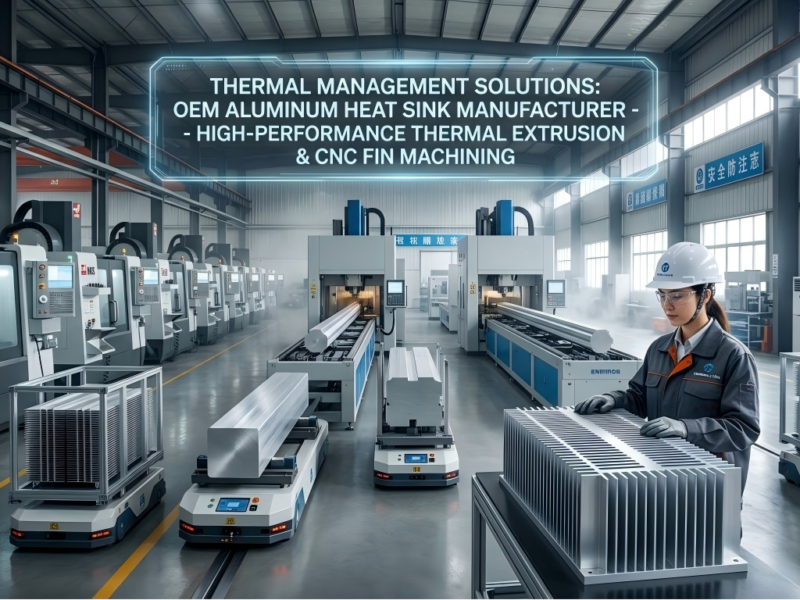
Consequently, our Taizhou facility operates heavy-tonnage extrusion presses. Therefore, these automated hydraulic machines push heated billets through hardened H13 steel dies. Furthermore, we achieve sub-millimeter dimensional accuracy constantly throughout the run. Moreover, this consistency guarantees perfect thermal contact with the processor. Thus, by centralizing our production in Zhejiang, we eliminate third-party fabrication defects. Consequently, we provide elite B2B aluminum extrusion services to global engineering firms.
Comparison Matrix: Thermal Component Materials
Procurement officers evaluate structural and financial viability during product development constantly. They analyze comparative metallurgical data to optimize cooling solutions. The following matrix contrasts core manufacturing materials based on thermal conductivity, capital tooling cost, and physical mass:
| Material & Process | Thermal Conductivity Rating | Capital Tooling & Manufacturing Cost | Weight & Structural Impact |
| Extruded Aluminum (6063-T5) | High (200 W/m·K). Offers exceptional heat dissipation for 90% of industrial and commercial electronic applications. | Low. Aluminum extrusion dies are highly economical to produce. Enables rapid prototyping and highly flexible OEM designs. | Lightweight. Maintains a low physical mass, reducing mechanical stress on the PCB and drastically lowering international freight costs. |
| Skived Copper Fins | Supreme (400 W/m·K). Delivers maximum possible heat transfer. Used strictly for extreme-wattage server CPUs and supercomputers. | High. Skiving requires specialized CNC peeling machines. Copper raw material costs heavily inflate the aggregate unit price. | Extremely Heavy. Copper adds massive physical weight to the circuit board, requiring heavy-duty mechanical mounting brackets to prevent PCB fracture. |
| Die-Cast Aluminum | Moderate (100 – 150 W/m·K). The casting process introduces microscopic air pockets, significantly lowering overall thermal conductivity efficiency. | Astronomical. Requires hardened steel injection molds costing tens of thousands of dollars before a single unit enters production. | Variable. Capable of creating highly complex 3D shapes, but the lower thermal conductivity requires much bulkier, heavier exterior designs. |
Surface Treatments for Maximum Emissivity
Executing a flawless thermal management strategy requires advanced surface chemistry. Bare, raw aluminum reflects thermal radiation poorly in passive environments. To optimize the cooling efficiency without relying entirely on mechanical fans, engineers alter the surface emissivity through highly specialized chemical treatments. We process our extruded cooling fins through state-of-the-art electrochemical baths to enhance their inherent thermodynamic properties.
Black Anodic Oxidation Physics
Black anodizing alters the surface emissivity radically. The electrochemical process utilizes a sulfuric acid bath and direct electrical current to create a highly porous, crystalline oxide layer on the aluminum substrate. Technicians introduce an organic black dye that fills these microscopic pores completely. Finally, a hot water seal locks the dye permanently inside the metal structure. A black anodized surface radiates heat outward far more efficiently than raw silver aluminum, drastically lowering the overall thermal resistance in natural convection (fanless) environments.
Preventing Galvanic Corrosion
Heat sinks frequently share contact points with varying metals, such as copper heat pipes or stainless steel mounting brackets. This continuous bimetallic contact creates a severe galvanic corrosion risk. Anodizing solves this critical failure mode by creating a thick dielectric barrier layer. This non-conductive barrier stops the electrochemical electron flow between the dissimilar metals. The heat sink survives harsh, humid industrial environments perfectly without oxidizing or structurally degrading.
Applying Thermal Paste Channels
A microscopic air gap ruins thermal transfer completely because ambient air acts as a severe thermal insulator. Engineers use thermal interface material (TIM) or thermal paste to bridge this microscopic gap. We utilize advanced CNC machines to mill micro-channels or apply a specific surface roughness (Ra value) to the exact base plate. These microscopic channels distribute the thermal paste evenly under heavy clamping pressure. They prevent ‘paste pump-out’ during the violent expansion and contraction of thermal cycling, ensuring permanent cooling efficiency for decades.
Frequently Asked Questions (FAQ)
1. What is the typical lifespan of a custom aluminum extrusion die?
A standard H13 tool steel extrusion die typically yields between 10,000 to 15,000 kilograms of extruded profile before microscopic wear alters the dimensional tolerances. We continuously monitor the die telemetry using coordinate measuring machines. Once it drifts out of tolerance, we CNC machine a replacement die in-house to guarantee your fin geometry remains mathematically perfect.
2. What is the minimum fin thickness tolerance your factory can extrude?
Utilizing premium 6063 aluminum billets and optimized hydraulic press speeds, we can consistently extrude cooling fins with a thickness down to 0.8mm to 1.0mm. This extreme mechanical tolerance allows for highly dense fin arrays, maximizing the active surface area for high-performance forced-convection cooling solutions.
3. How do you handle bulk shipping logistics from the Taizhou facility?
Taizhou is a major manufacturing and export hub. We palletize the aluminum heat sinks using ISPM-15 certified wooden crates to survive ocean freight. We interleave the profiles with protective craft paper to prevent abrasive scratching during transit. We coordinate directly with Ningbo and Shanghai ports to execute rapid FCL (Full Container Load) ocean dispatch.
4. Can you CNC machine mounting holes and threads after the extrusion process?
Yes. Extrusion only creates the continuous linear 2D profile. We operate a massive fleet of automated CNC tapping and drilling centers. We machine precise mounting holes, tap threaded sockets, and mill the base plate to an ultra-flat finish (reducing the Ra value) before the anodizing process ever begins.
5. Does black anodizing impact the overall thermal resistance of the heat sink?
Yes, it improves it significantly. While the thin oxide layer itself acts as a slight thermal insulator, the dark black color drastically increases the radiant emissivity of the aluminum (shifting it from roughly 0.05 to over 0.80). In natural convection applications lacking forced airflow, a black anodized heat sink performs significantly cooler than a bare aluminum unit.
6. What is the standard Minimum Order Quantity (MOQ) for a custom heat sink profile?
Because metal extrusion is a high-volume, continuous thermodynamic process, standard MOQs typically start at 500 kilograms per custom die. This minimum volume ensures the hydraulic press operates efficiently and absorbs the thermal setup costs. However, we frequently offer rapid prototyping services to test the thermal dynamics before committing to the full mass-production tonnage.
Conclusion
The engineering reality within the global electronics market is irrefutable. Securing highly reliable thermal management prevents catastrophic hardware failure. You must source your structural cooling components from a highly verified custom aluminum extrusion China factory. We engineer precision components that guarantee absolute temperature control for delicate silicon architectures. By migrating your procurement to our facility, you acquire flawless quality control.
Partner with industrial aluminum profile manufacturer experts today to eliminate thermodynamic bottlenecks. We deliver precision manufacturing directly from our heavy-tonnage presses in Taizhou. Secure your bulk extrusion orders with our expert mechanical engineers. Upgrade your electronic hardware with premium heat dissipation solutions. Contact our aluminum extrusion service team and revolutionize your global B2B supply chain now.