

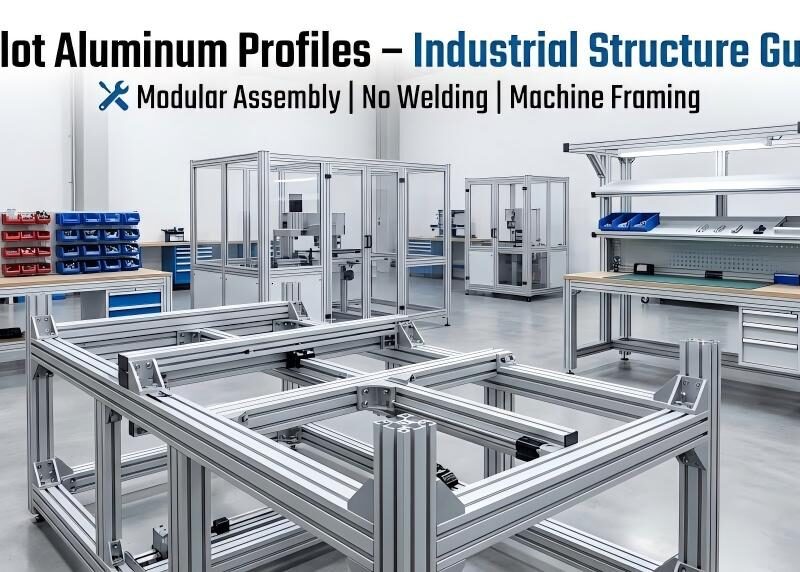
Introduction: The “Lego” of Industrial Engineering
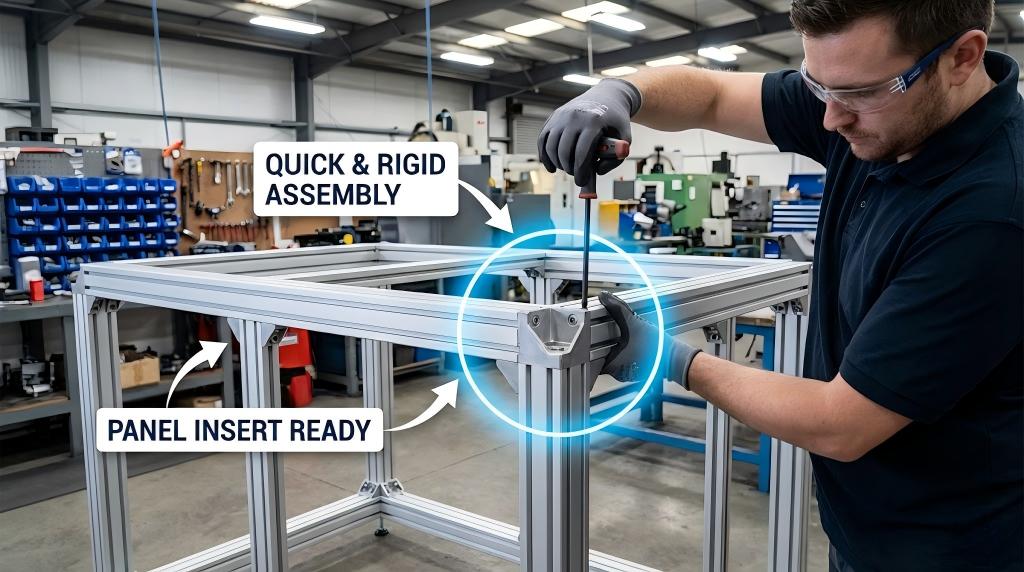
In the fast-paced world of manufacturing, flexibility is currency. Traditional methods of building factory infrastructure—welding steel tubes, grinding welds, and painting frames—are slow, permanent, and rigid. If the production line changes, the welded frame often goes to the scrap yard. Enter the T-slot aluminum profile.
Often referred to as ‘Industrial Lego’ or ’80/20′ framing, T-slot aluminum extrusion has revolutionized how engineers build machine bases, safety guards, workstations, and automation gantries. The system relies on a simple yet powerful concept: a modular profile with T-shaped grooves running along its length, allowing components to be bolted anywhere, anytime, without drilling.
This guide dissects the engineering principles behind Anrele’s modular framing systems. We will explore the structural advantages over steel, decode the numbering series (2020 vs 4040), and examine the critical fasteners that hold it all together. Whether you are mounting pneumatic cylinders or building a cleanroom enclosure, this is your blueprint.
Advantages of Modular Aluminum Structures vs. Welded Steel
Why pay more for aluminum when steel is cheaper per kilogram? The answer lies in the ‘Total Installed Cost’ and ‘Life Cycle Flexibility’.
No Welding, No Painting
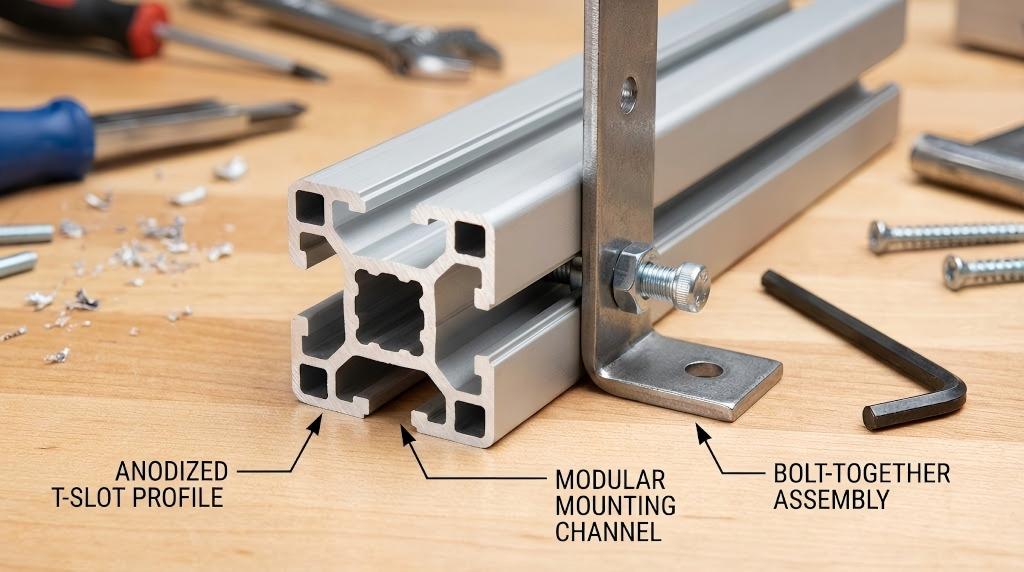
Steel frames require a skilled welder, followed by grinding, priming, and painting to prevent rust. This process takes days. T-slot profiles come pre-anodized (usually clear or black) for a durable, aesthetic finish. Assembly requires only a hex key (Allen wrench).
Infinite Adjustability
Did a design error place a sensor bracket 50mm too low? On a welded frame, you must cut and re-weld. On a T-slot frame, you simply loosen the bolt, slide the bracket up, and retighten. This adaptability is crucial for prototyping and evolving production lines.
Series Overview: 20, 30, 40, and 45 Series
Anrele profiles are categorized by their metric cross-section dimensions. Choosing the right series is the first step in design.
20 Series (20mm x 20mm)
• Slot Width: 6mm
• Application: Light-duty enclosures, 3D printer frames, and sensor mounts. Not for structural loads.
30 Series (30mm x 30mm)
• Slot Width: 8mm
• Application: Medium-duty guarding, display racks, and laboratory test rigs.
40 Series (40mm x 40mm) – The Industry Standard
• Slot Width: 8mm or 10mm• Application: Heavy machine bases, workstations, and conveyor supports. This is the most versatile profile, offering a balance of strength and weight comparable to our solar mounting rails.
Heavy Duty Profiles (4545, 8080, 9090)
For spans exceeding 2 meters or loads exceeding 500kg, we move to heavy-duty profiles with thicker walls and internal webbing.
Fasteners and Accessories: The Hidden Strength
The profile is only as strong as its connection. Understanding T-Nuts is vital.
T-Nuts: Hammer vs. Slide-In
• Slide-In Nuts: Inserted from the end of the profile. Very strong but must be pre-planned before assembly.
• Hammer Nuts (Drop-in): Can be inserted anywhere along the slot by rotating them 90 degrees. Ideal for adding accessories to an existing frame.
Brackets and Gussets
• Die-Cast Brackets: Low cost, good for static loads.
• Machined Plate Gussets: High strength, used for high-vibration machinery bases.
Common Industrial Structure Applications
Ergonomic Workstations
Using T-slots allows for height-adjustable tables, monitor arms, and tool holders. The aluminum naturally dissipates static electricity (ESD safe) when properly grounded.
Machine Guarding
Safety fences with polycarbonate or wire mesh panels slide directly into the T-slot channels, creating a clean, rattle-free barrier around dangerous robots or stamping presses.
Load Capacity and Design Considerations
Designing with aluminum requires calculating deflection using the Moment of Inertia (Ix, Iy). Aluminum has a Modulus of Elasticity (E) of ~70 GPa, roughly 1/3 that of steel. This means for the same load, aluminum will deflect 3x more than a steel bar of identical size. To counteract this, we select larger profiles (e.g., using 4080 instead of 4040) to increase stiffness. Our engineering services can assist with load calculations.
Conclusion: The Versatile “Lego” for Engineers
T-slot aluminum profiles have democratized industrial design. They allow a maintenance technician to build a custom cart in the morning and a safety guard in the afternoon, with zero welding fumes and zero painting delays.
Anrele stocks a comprehensive range of metric profiles and accessories. Whether you are retrofitting a factory or building a new product line, our modular systems provide the speed and rigidity you need. Contact us to request our profile catalog or discuss a custom cut-to-length order.
Learn more about our company history and manufacturing capabilities at About Anrele.
FAQ: Common Technical Questions
1. How strong are T-slot aluminum profiles?
Strength depends on the ‘Moment of Inertia’ of the specific profile. A standard 4040 profile can typically support a point load of ~100kg over a 1-meter span with minimal deflection. Heavy-duty versions (4080, 8080) can support tons.
2. Can T-slot profiles be used outdoors?
Yes. Anodized aluminum is highly corrosion-resistant. It will not rust like steel. However, the clear anodizing may fade slightly over years of UV exposure. For harsh environments, use 10µm+ anodizing thickness.
3. Do connections loosen over time under vibration?
Vibration can loosen bolts. To prevent this in dynamic machinery applications, use spring washers, thread-locking fluid (Loctite), or specialized high-tension vibration-proof fasteners.
4. What is the difference between T-Slot and V-Slot?
T-Slot is designed for structural framing and static loads. V-Slot has chamfered edges on the slot, allowing wheels to roll inside the track. V-Slot is primarily used for linear motion rails (like 3D printers), not heavy structures.
5. Does Anrele offer cut-to-length services?
Yes. We offer precision cutting services with a tolerance of ±0.5mm. We can also drill and tap the ends for butt-joint assembly.
6. Which T-nut is better: Hammer nut or Slide-in nut?
Hammer nuts (Drop-in) offer convenience as they can be added to a built frame. Slide-in nuts offer higher strength as they have more surface area contact with the T-slot lip. Use Slide-in for heavy structural joints, Hammer for accessories.
For electrical safety, ensure frames are grounded. See our grounding terminals for solutions.