Introduction: The Shield Against Entropy
Aluminum is a reactive metal. The moment it leaves the extrusion press and meets the oxygen in the air, it forms a thin, natural oxide layer. While this provides some protection, it is insufficient for the harsh realities of industrial environments. Salt spray, UV radiation, and mechanical abrasion will quickly degrade raw aluminum, leading to pitting and structural weakness. This is why surface finishing is not just cosmetic; it is a critical engineering specification.
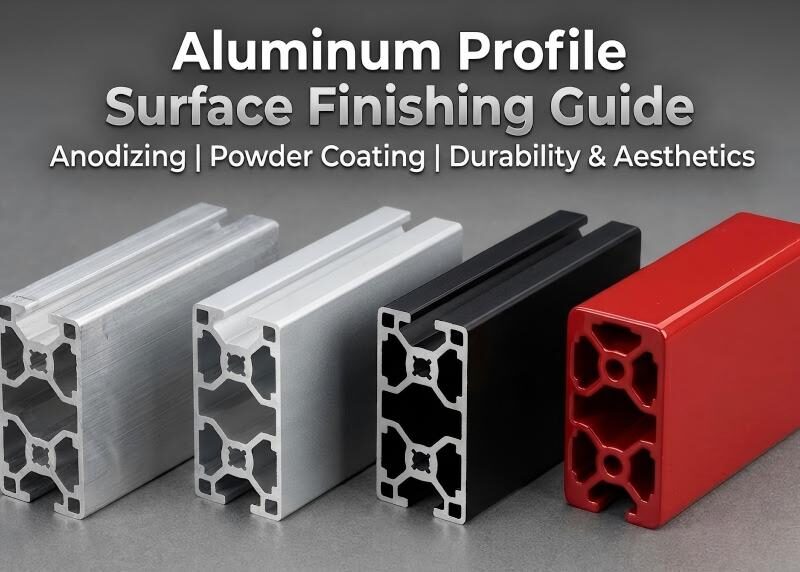
Choosing the right finish—whether it’s the electrochemical hardness of anodizing aluminum profiles, the polymer durability of powder coating, or the sleek smoothness of electrophoresis—can determine the lifespan of your product. At Anrele, we offer a full spectrum of finishing services tailored to your application’s environment.pneumatic cylinder tubes to resist piston wear.
This guide compares the three dominant finishing technologies, analyzing their chemical processes, durability metrics, and suitability for different industrial sectors.
The Anodizing Aluminum Profiles Process and Benefits
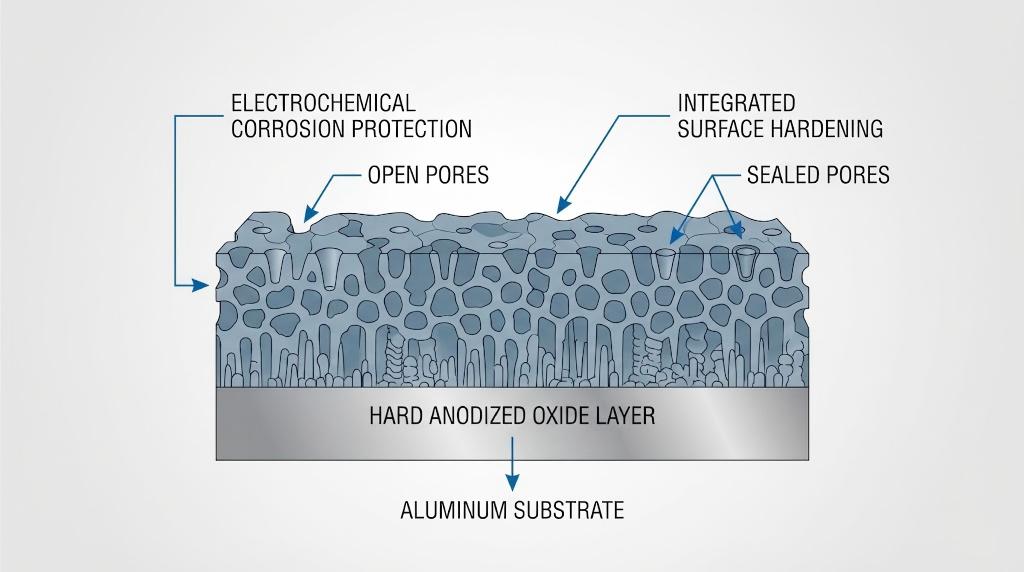
Anodizing is unique among finishes because it is not a coating applied to the surface; it is a transformation of the surface itself.
The Electrochemical Reaction
The aluminum profile is submerged in an acid electrolyte bath and an electric current is passed through it. This drives oxygen ions into the aluminum surface, growing a uniform layer of Aluminum Oxide (Al₂O₃). This crystal structure is incredibly hard—second only to diamonds on the Mohs scale.
Key Benefits:
• Durability: Since the oxide layer is integrated with the metal substrate, it cannot peel or chip like paint.
• Hardness: Standard anodizing (Type II) offers good wear resistance. Hard Anodizing (Type III) creates a ceramic-like surface used in our
• Aesthetics: The porous nature of the oxide layer before sealing allows it to absorb dyes, enabling metallic colors like Black, Gold, or Blue.
Powder Coating Characteristics and Color Options
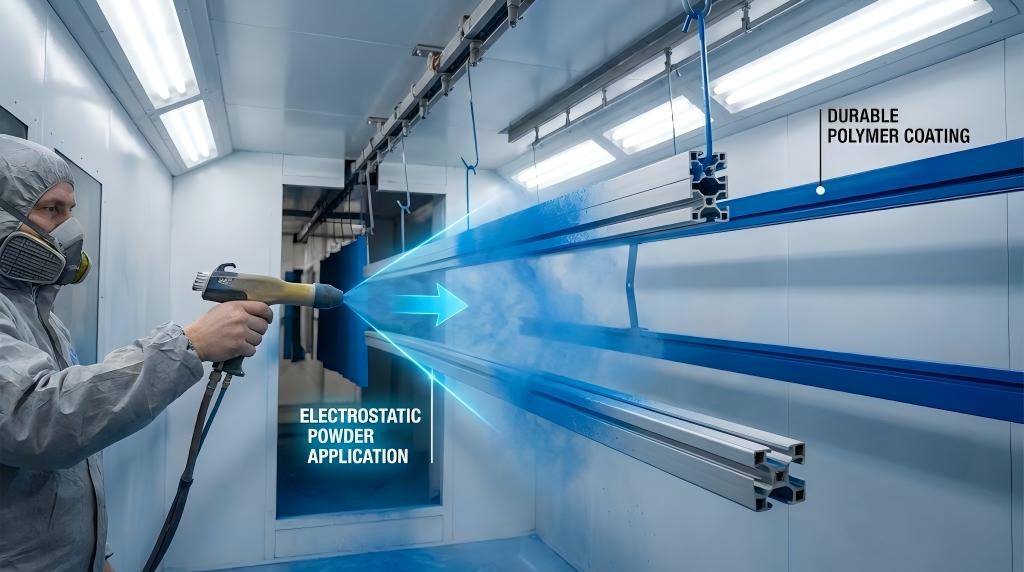
Powder coating is a dry finishing process where free-flowing thermoplastic powder is applied electrostatically and then cured under heat to form a ‘skin’.
Advantages over Anodizing
• Chemical Resistance: Polymer powders (Epoxy or Polyester) offer superior resistance to acids and alkalis that might dissolve an anodized layer.
• Color Consistency: Powder coating guarantees identical color matching across batches (e.g., RAL 9005 Jet Black), which can be difficult to achieve with organic anodizing dyes.
• Coverage: It can hide surface extrusion lines or die marks, providing a uniform matte or gloss finish.
Electrophoresis: The Premium Finish
Electrophoresis (E-coating) is a hybrid process. The aluminum is first anodized, and then, while the pores are still open, a clear or colored lacquer resin is deposited electrically into the pores before sealing.
The ‘Champagne’ Look
This results in a finish that has the metallic sheen of anodizing but the surface smoothness of a coating. It is highly resistant to fingerprints and stains, making it the preferred choice for high-end architectural custom aluminum profiles and luxury furniture frames.
Choosing Finishes for Different Environments (Marine vs. Indoor)
Environment dictates specification. A finish that works in a warehouse may fail on an oil rig.
| Environment | Recommended Finish | Why? |
| Indoor / Dry | Standard Anodizing (10µm) | Cost-effective, maintains metallic look. |
| Outdoor / Solar | Thick Anodizing (20-25µm) | Resists UV degradation and rain erosion. Standard for solar clamps. |
| Marine / Coastal | Powder Coating (Qualicoat Seaside) | Seals the metal completely from salt mist (chlorides). |
| Heavy Industrial | Hard Anodizing (50µm) | Maximum abrasion resistance for moving parts. |
For solar projects specifically, check our Solar Mounting category where we standardize on high-micron anodizing.
Quality Standards and Inspection Methods
How do you know the finish will last? We rely on global standards.
• Film Thickness: Measured using Eddy Current gauges. We guarantee min 10µm for standard anodizing.
• Salt Spray Test (ASTM B117): Profiles are exposed to a saline fog. Our marine-grade finishes must pass 3000+ hours without blistering.
• Seal Integrity (ASTM B136): A dye stain test ensures the anodized pores are fully sealed to prevent staining.
Learn more about our quality control lab on our About Us page.
Conclusion: Aesthetics Meets Protection
Surface finishing is the final step in manufacturing, but the first thing your customer sees. It defines the perceived quality of the product.
Whether you need the rugged utility of hard anodizing or the vibrant durability of powder coating, Anrele has the facility to deliver. We encourage OEM partners to consult with us early in the design phase to select the most cost-effective finish for the application. Contact our team for a sample kit of our surface finishes.heat sinks needing grounding.
FAQ: Common Technical Questions
1. Which finish offers better corrosion resistance?
For acidic/alkaline chemical resistance, Powder Coating is superior. For salt spray and weather resistance, high-thickness Anodizing (>20µm) or Electrophoresis performs best.
2. Does anodizing affect aluminum strength?
No. Anodizing is a surface treatment and does not alter the tensile strength or yield strength of the aluminum alloy core.
3. Does anodizing change the dimensions of the part?
Yes, slightly. Anodizing grows the surface by roughly half the total coating thickness. For a 20µm coating, the part diameter grows by ~10µm. This must be accounted for in precision parts like cylinder bores.
4. Can anodized aluminum conduct electricity?
No. Aluminum oxide is an excellent electrical insulator. If grounding is required, contact points must be masked during anodizing to expose raw aluminum. This is critical for
5. Is powder coating more durable than anodizing?
Powder coating is more resistant to impact (it bends rather than cracking), but it can peel if the substrate is damaged. Anodizing is harder (scratch resistant) and cannot peel, but it can crack if the aluminum is bent sharply.
6. Can you match custom RAL colors?
Yes. For powder coating, we can match any RAL color code. For anodizing, color matching is more difficult due to alloy variations, but we offer a range of standard metallic shades (Gold, Bronze, Black, Champagne).