

Introduction:
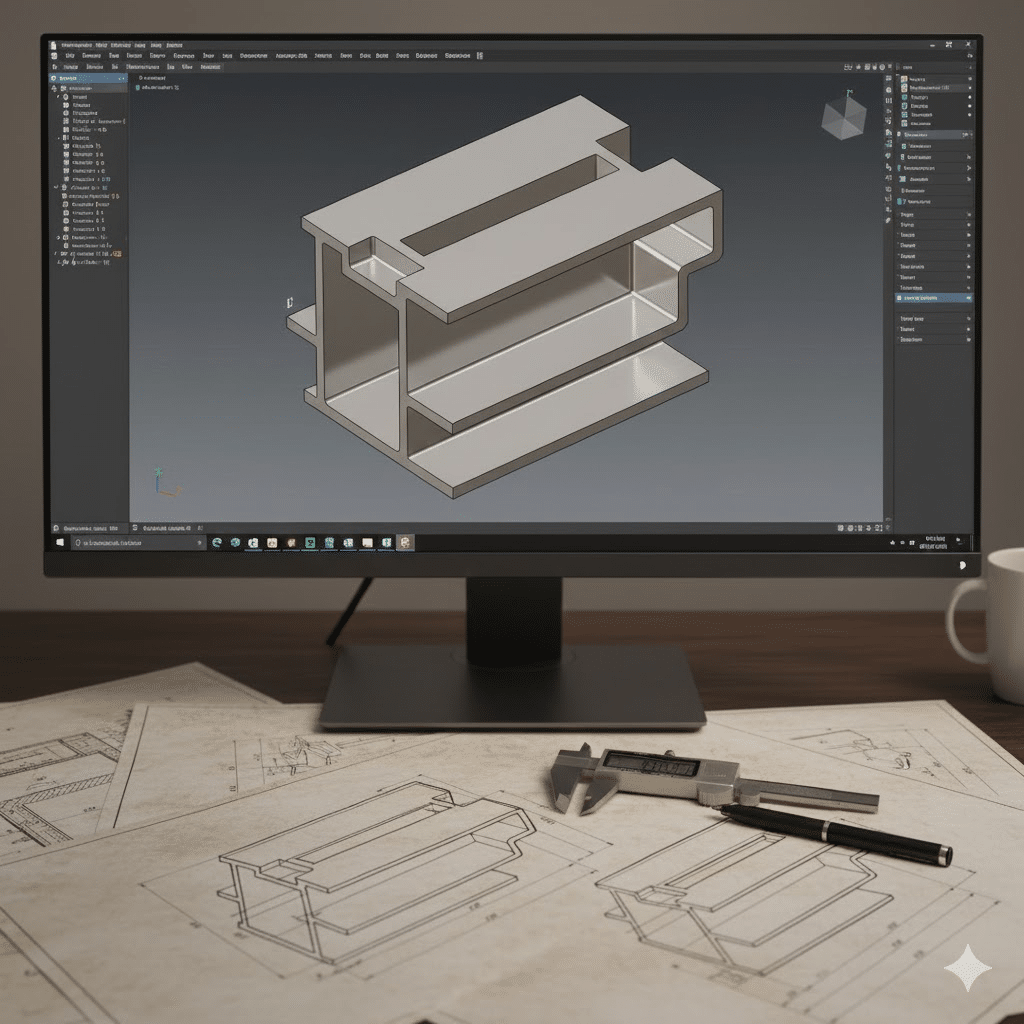
Engineers often start their design process with standard catalogs: T-slots, L-angles, and tubes. But standard shapes force compromises. They add unnecessary weight, require extra fasteners, or fail to meet specific thermal or aerodynamic requirements. When you are designing a high-performance product—whether it’s an EV battery housing or a medical device frame—off-the-shelf components simply don’t cut it.
The solution is Custom Aluminum Extrusion. However, many engineers hesitate to design custom profiles because they fear high tooling costs and complex lead times. They default to CNC machining from solid blocks, which is slow, wasteful, and expensive.
In reality, aluminum extrusion is one of the most cost-effective manufacturing processes for mid-to-high volume production. Unlike plastic injection molding (where molds cost $10,000+), an aluminum extrusion die often costs less than $1,000. In this engineering guide, the Anrele team pulls back the curtain on the extrusion process. We will dive into the physics of Plastic Deformation, the difference between Solid and Hollow Dies, and the mathematical formulas (like Tongue Ratio) you need to determine if your design is manufacturable.
1. The Physics: Plastic Deformation and Flow Stress
Extrusion is often compared to squeezing toothpaste from a tube, but the physics are far more violent. It involves forcing a solid metal billet through a steel die under massive pressure, causing it to flow like a viscous fluid.
The Process Parameters
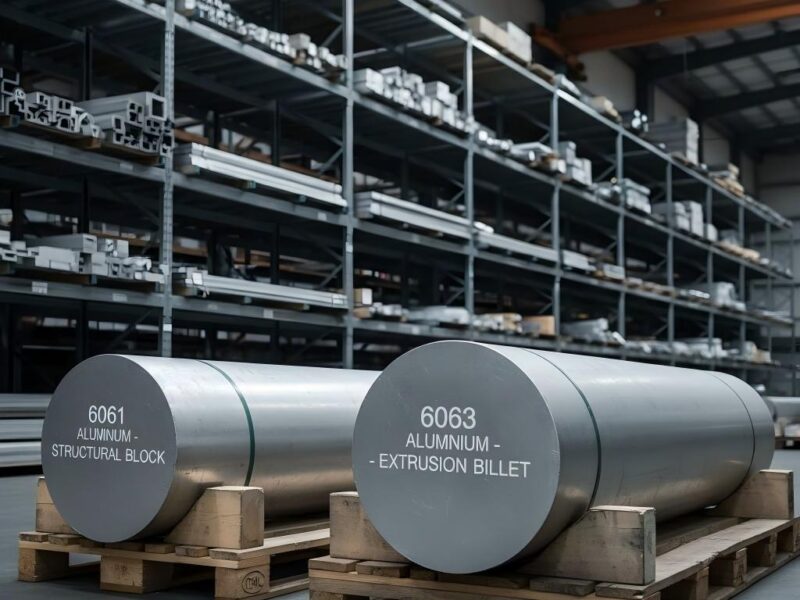
1. Billet Pre-Heat (The Plastic Zone): The aluminum log (typically 6063 or 6005A) is heated to 450°C – 500°C. It is not melted (aluminum melts at 660°C); it is softened to a ‘plastic’ state where the Yield Strength drops significantly.
2. The Dead Metal Zone: As the hydraulic ram pushes the billet into the container, the aluminum in the corners of the container does not move. This forms a ‘Dead Metal Zone.’ The material flows from the center of the billet, shearing past this dead zone. This friction generates immense heat. If the extrusion speed is too fast, this frictional heat pushes the aluminum past its melting point, causing surface tearing known as Hot Shortness.
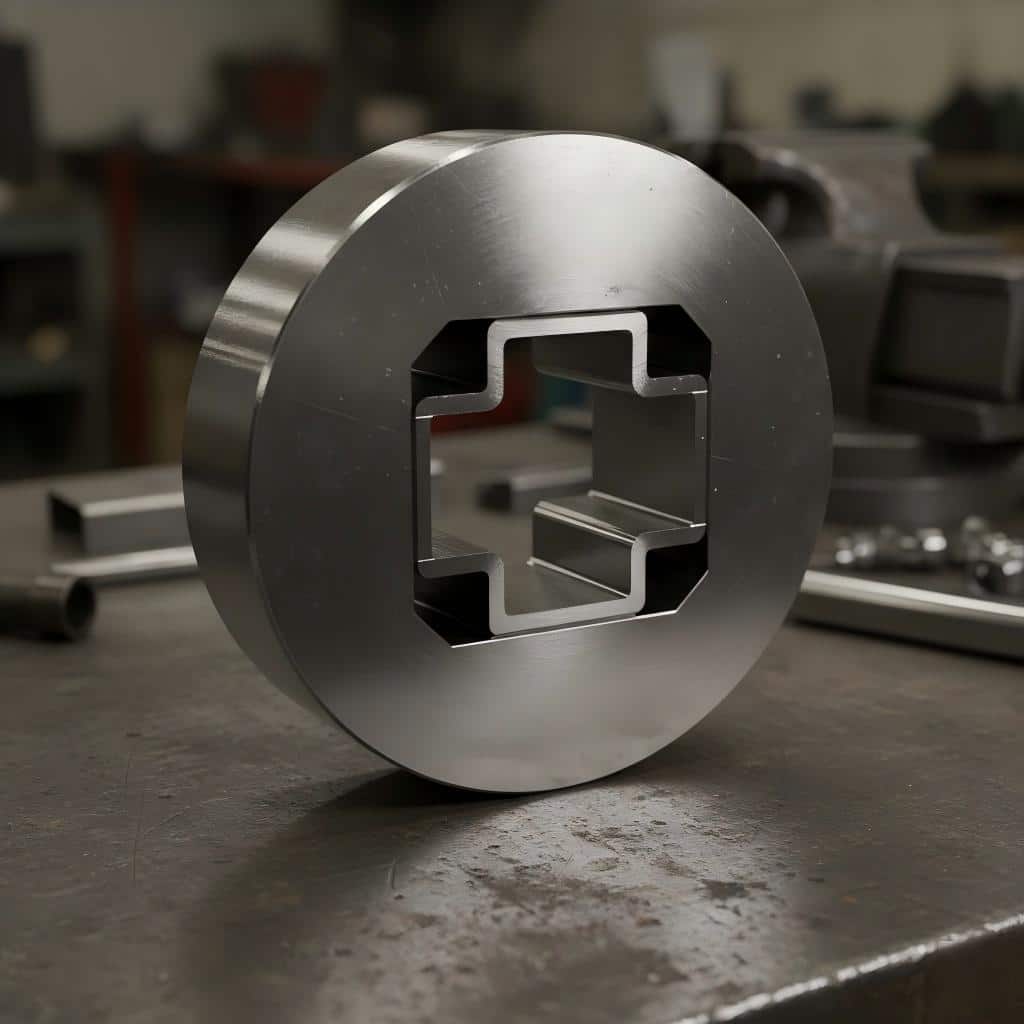
3. The Welding Chamber (Hollow Profiles): How do we extrude a hollow square tube? The die cannot have a floating center core. Instead, we use a Porthole Die. The metal stream is split into 2 or 4 separate streams to flow around the ‘legs’ that hold the center mandrel. Inside the high-pressure welding chamber *behind* the die exit, these streams are forced back together. Under extreme heat and pressure, they fuse back into a solid metal structure. This creates invisible ‘Weld Seams’ running down the length of every hollow profile.
2. Die Design: Controlling the Flow
The secret to a straight profile lies in the die’s Bearing Length. Metal wants to flow faster in the center of the die (least friction) and slower at the edges (wall friction). If this isn’t balanced, the profile will come out twisted.
Bearing Control:The die maker adjusts the length of the ‘bearing’ (the surface that touches the aluminum). By making the bearing longer in the center, we add friction to slow down the flow. By making it shorter at the tips, we speed it up. This balances the velocity across the profile face.
3. DFM Math: Is Your Part Extrudable?
Before sending Anrele a drawing, check these three calculations to ensure manufacturability.
A. The Extrusion Ratio (R)
$$R = \frac{Area_{billet}}{Area_{profile}}$$
• Ideal Range: 10 to 60.
• If R < 10: The metal is not worked enough. The crystal structure will be coarse, leading to poor mechanical strength.
• If R > 70: The pressure required is too high. The die may break, or the press will stall.
B. The Tongue Ratio (Crucial for Heat Sinks)
If your design has a deep, narrow slot (like a fin on a heat sink), you risk snapping the die steel. The Tongue Ratio is the depth of the groove divided by the width of the gap.
$$Tongue Ratio = \frac{Depth}{Gap}$$
Anrele Limit: generally 3:1 for standard dies. With special high-strength die steel (H13), we can achieve 4:1. Anything higher requires a specialized ‘hollow’ die design.
C. Circumscribing Circle Diameter (CCD)
This is the diameter of the smallest circle that completely encloses your profile. Our presses handle a CCD up to **300mm**. Wider profiles must be designed as interlocking parts.
4. Heat Treatment: T4 vs T5 vs T6
The extrusion process doesn’t end at the press. The temper (hardness) is determined by how we cool it.
T4 (Naturally Aged): Quenched at the press but not baked. It remains soft and ductile, allowing for bending or forming operations.
T5 (Air Quenched + Artificially Aged): The standard for 6063. The profile is cooled by forced air fans at the press exit, then baked in an Aging Oven at 200°C for 6-8 hours. This precipitates the Magnesium-Silicide crystals, hardening the alloy.
T6 (Water Quenched + Artificially Aged): The standard for 6061 structural parts. Because 6061 is quench-sensitive, air cooling is too slow. We must spray the hot profile with water mist (or submerge it) to ‘freeze’ the crystal structure instantly. This results in maximum strength but introduces internal stress.
5. Comparison: Extrusion vs. CNC vs. Die Casting
| Feature | Aluminum Extrusion | CNC Machining (Solid) | High Pressure Die Casting |
| Material | 6063, 6005A, 6061 | 6061, 7075 | A380, ADC12 |
| Tooling Cost | Low ($500 – $1500) | Zero ($0) | High ($10,000+) |
| Unit Cost | Low (Material + Process) | High (Machine Time + Waste) | Lowest (High Volume) |
| Min Order (MOQ) | Medium (300kg) | Low (1 unit) | High (5000 units) |
| Max Length | Long (6 meters+) | Short (< 1 meter) | Short (Complex 3D shapes) |
| Surface Finish | Excellent (Anodize ready) | Good (Tool marks) | Fair (Flow lines) |
| Strength | High (Wrought structure) | High | Medium (Porosity) |
6. ROI Analysis: The Break-Even Point
Scenario: You need 1,000 units of a 100mm long special aluminum bracket.
Option A: CNC Machining from Bar Stock
• Stock Material: $2.00
• Machining Time: 10 mins @ $60/hr = $10.00
• Total Unit Cost: $12.00
• Total Project Cost:$12,000
Option B: Custom Extrusion + Saw Cut
• Mold Cost (NRE): $800 (One time)
• Extruded Profile Cost (per 100mm): $1.50
• Saw Cutting: $0.20
• Total Unit Cost: $1.70
• Total Project Cost: $800 + (1000 × 1.70) = $2,500
ROI Conclusion: By switching to custom extrusion, you save $9,500 on the first order alone. The mold pays for itself after just 70 parts.
7. Alloy Selection: Beyond 6063
While 6063 is the standard, Anrele offers specialized alloys for custom profiles.
• 6063-T5 (Architectural):The best surface finish. Ideal for visual parts, heat sinks, and solar clamps. Yield Strength ~145 MPa.
• 6061-T6 (Structural):High strength. Harder to extrude (requires slower press speeds). Surface finish is slightly duller due to Magnesium/Silicon grain. Yield Strength ~276 MPa.
• 6005A-T6 (The Hybrid): A modern European favorite. It offers strength close to 6061 (~260 MPa) but extrudes almost as well as 6063. It is the preferred choice for automotive chassis and high-speed rail profiles.
8. Extended FAQ: Custom Manufacturing
Q1: What is the minimum wall thickness you can extrude?
A: Generally 0.8mm to 1.0mm for small profiles (CCD < 50mm). For larger profiles, we recommend at least 1.5mm. Walls that are too thin can tear or ripple (‘oil canning’) due to uneven cooling.
Q2: What are ‘Die Lines’?
A: Die lines are faint longitudinal lines on the surface caused by friction in the die bearing. They are unavoidable in extrusion but can be minimized by Anrele’s polishing process.
Q3: Can you hold tighter tolerances than standard (EN 755)?
A: Standard extrusion tolerance is roughly +/- 0.15mm. For mating parts, Anrele can achieve Precision Tolerance (+/- 0.05mm), but this requires slower press speeds and frequent die maintenance.
Q4: How long does it take to make a new die?
A: Typically 10 to 12 days for die design and manufacturing. We then run a ‘T1 Trial’ to produce samples for your approval.
Q5: Can you extrude screw ports (screw bosses)?
A: Yes. We often extrude ‘C-channels’ designed to accept self-tapping screws. This eliminates the need for drilling and tapping holes later, saving huge assembly costs.
Q6: Why is my profile twisted?
A: Twisting usually happens if the cross-section is unbalanced (heavy on one side, thin on the other). We fix this by stretching the profile after extrusion, but severe asymmetry should be corrected in the design phase.
Conclusion
Custom Aluminum Extrusion is not reserved for giants like Apple or Tesla. With low tooling costs and Anrele’s engineering support, it is accessible to any business needing specific geometries.
By designing a custom profile, you can integrate features (screw bosses, heat sink fins, sensor slots) directly into the raw material, eliminating secondary machining and assembly steps. It is the ultimate Design for Manufacturing (DFM) move.
Ready to shape your future? Send your DXF or STEP file to Anrele Engineering for a Free Die Design Review and Feasibility Report.