

Introduction
Procurement officers face immense financial risks constantly within the global industrial manufacturing sector. Receiving a 40-foot shipping container full of defective metal halts global production lines instantly. You must master strict metallurgical parameters to prevent catastrophic manufacturing downtime across your automated facilities. Implementing absolute aluminum extrusion quality control protects your heavy industrial investments perfectly. Generic brokers ignore these critical mechanical inspection protocols entirely to save production money.
Unverified factories frequently ship structurally compromised aluminum profiles to unsuspecting global buyers. These inferior metal components feature massive dimensional variations and severe internal metallurgical voids. A warped structural beam destroys your robotic assembly sequence immediately upon arrival. Microscopic internal fractures cause high-pressure pneumatic cylinders to burst violently during routine factory operation. You must eliminate this severe mechanical vulnerability completely before committing to a bulk metal purchase.
You must upgrade your industrial component supply chain urgently today. Partner directly with an elite Original Equipment Manufacturer (OEM) that executes advanced metrology and physical testing. This technical guide deconstructs the exact physics of identifying major aluminum extrusion defects. We analyze precision coordinate measuring machines and strict ultrasonic structural flaw detection. We reveal how advanced vertically integrated facilities guarantee absolute mechanical perfection for your components.
Identifying and Mitigating Surface Defects
Flawless structural components require absolutely perfect exterior metal surfaces constantly. Severe surface defects ruin high-end architectural aesthetics instantly and create massive stress concentrators. The hydraulic extrusion press generates immense thermodynamic friction during operation. We engineer strict preventative protocols to neutralize these destructive frictional forces.
Preventing Die Lines and Scoring
Die lines appear as continuous longitudinal scratches along the entire metal profile. The hot aluminum drags against the microscopic bearing surface of the H13 steel die. A rough die bearing scores the soft aluminum violently as it exits the press. We prevent this by polishing the steel die bearings to a flawless mirror finish. Technicians execute advanced gas nitriding processes to harden these steel bearings further. This nitriding protocol creates an ultra-smooth, wear-resistant surface that eliminates longitudinal scoring entirely. You receive a perfectly clean, architectural-grade finish on every single extruded piece.
Eliminating Surface Blistering
Blisters look like tiny metallic bubbles bursting out from the flat aluminum surface. This defect occurs when the factory traps atmospheric moisture inside the heated billet. The intense hydraulic press pressure superheats this trapped moisture into expanding hydrogen gas instantly. The expanding gas physically tears the hot metal surface open upon exiting the die. We eliminate blistering by operating advanced rotary degassing equipment during the billet casting phase. We remove all trapped hydrogen atoms from the molten metal pool completely. We guarantee dense, solid profiles continuously.
Managing Graphite Inclusion
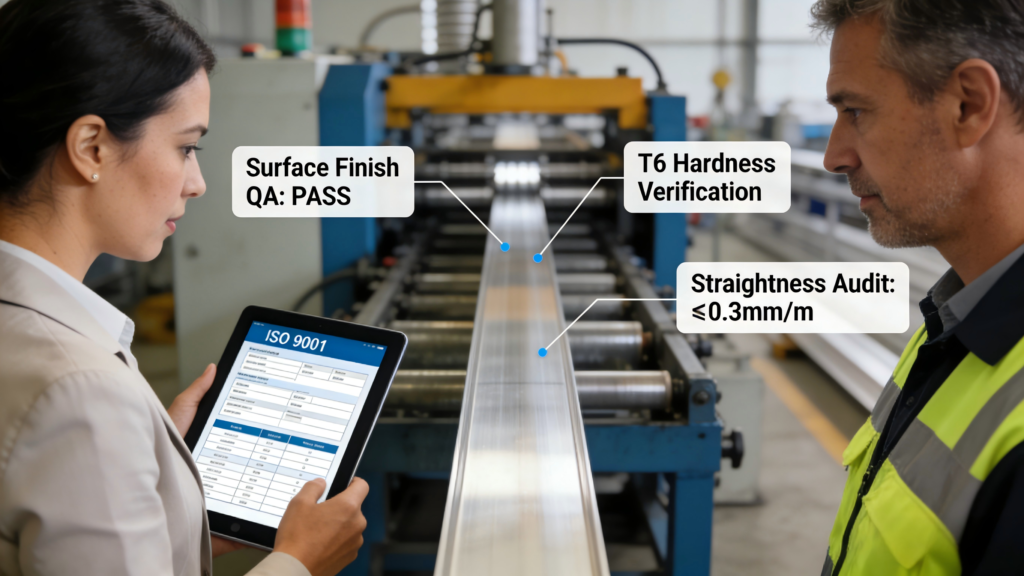
Press operators frequently apply heavy graphite lubricants to the extrusion press dummy block. This lubricant prevents the hot billet from sticking to the hydraulic ram. Sometimes, this dark graphite runs off and embeds itself into the hot aluminum profile. This carbon contamination ruins subsequent anodizing baths and destroys the premium aesthetic finish. We utilize specialized high-temperature synthetic boron nitride lubricants instead. We monitor the application volume strictly to prevent any carbon contamination on your raw profiles. We execute flawless surface finish QA across all production batches.
Strict Metrology and Inspection in Taizhou
Furthermore, extreme dimensional accuracy requires massive investment in specialized metrology equipment constantly. Taizhou provides this exact mechanical verification ecosystem perfectly for global buyers. Consequently, we leverage local high-precision testing laboratories daily without external delays. Therefore, we execute continuous geometric verification operations rapidly. Moreover, this centralized heavy industrial hub eliminates third-party metrology friction completely. Thus, we deliver pure mathematical reliability directly to your remote engineering teams.
Utilizing Coordinate Measuring Machines (CMM)
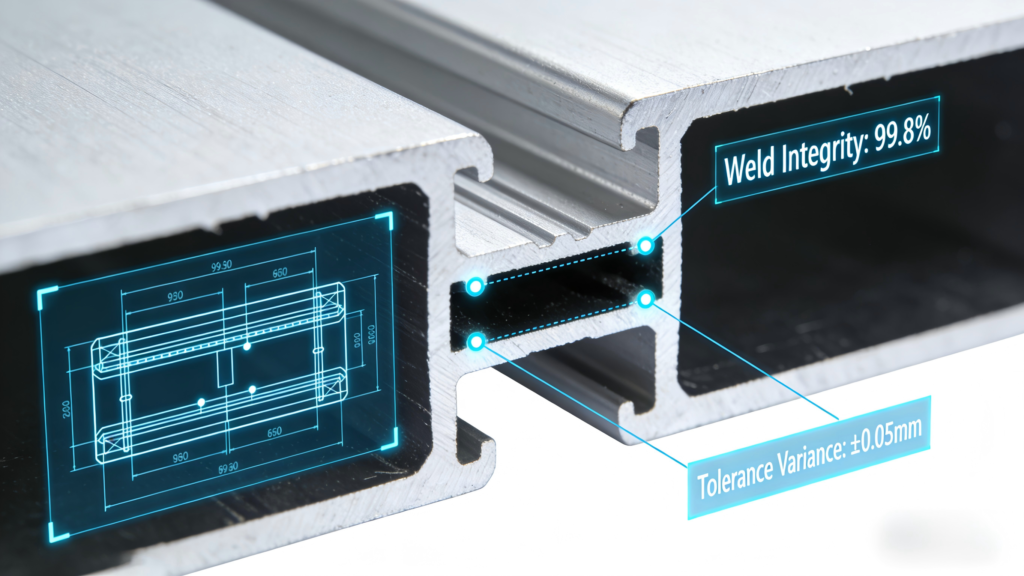
Furthermore, modern robotic assembly demands absolutely perfect 3D spatial geometry continuously. Calipers and simple hand tools fail to measure complex internal profile chambers accurately. Therefore, our quality control engineers utilize advanced Coordinate Measuring Machines (CMM) constantly. Consequently, a highly sensitive ruby-tipped probe touches the aluminum profile across a three-dimensional grid. Thus, the computer maps the exact physical geometry against your original engineering CAD file perfectly. Moreover, this automated process guarantees absolute compliance with your strict dimensional tolerance inspection parameters.
Verifying Wall Thickness Tolerances
Consequently, uneven wall thickness destroys high-pressure pneumatic cylinder performance instantly. The extrusion die core shifts slightly under extreme hydraulic pressure during the run. Therefore, we deploy advanced ultrasonic thickness gauges across the entire profile length. Consequently, high-frequency sound waves bounce through the solid metal walls rapidly. Thus, the digital gauge measures the precise internal wall thickness down to the micron. Moreover, we halt the extrusion press immediately if the wall thickness deviates beyond the acceptable standard.
Executing ISO 9001 Protocols
Moreover, maintaining this extreme accuracy requires rigorous statistical process control (SPC) continuously. Therefore, we monitor the Process Capability Index (CPK) for every critical dimension strictly. Consequently, a CPK value above 1.33 mathematically proves our manufacturing process remains highly stable. Thus, we eliminate random mechanical variation and reduce the defect parts per million (DPPM) significantly. Partnering with a verified ISO certified aluminum factory protects your global reputation completely.
Comparison Matrix: Extrusion Tolerance Standards
Mechanical engineers evaluate acceptable geometric variances and scrap rates constantly. They analyze comparative metrology data to optimize heavy industrial systems. The following matrix contrasts core manufacturing tolerance standards based on acceptable variance, operational scrap rates, and overall production cost:
| Tolerance Standard | Acceptable Variance (Millimeters) | Factory Scrap Rates & Process Capability | Manufacturing Cost & Industry Application |
| Standard Commercial Tolerances (EN 755-9) | High (+/- 0.3mm to 0.5mm). Allows for significant geometric variation across the metal profile length. | Low. The factory rejects very few pieces. The die runs longer before requiring replacement or CNC correction. | Very Low. Ideal for generic architectural framing, standard window frames, and non-critical structural brackets. |
| Precision Industrial Tolerances | Low (+/- 0.1mm to 0.15mm). Requires strict control over billet temperature and hydraulic ram extrusion velocity. | Moderate. The QA team rejects profiles that bow or twist slightly. The factory must replace the H13 steel dies more frequently. | Moderate. Used extensively for precision pneumatic cylinders, automated T-slot modular framing, and high-density heat sinks. |
| Aerospace / Automotive Tolerances | Extremely Low (+/- 0.05mm). Demands perfect thermodynamic control, isothermal extrusion, and rigorous post-extrusion CNC machining. | High. The factory scraps massive amounts of metal. Technicians execute 100% CMM inspection on every single individual component. | Astronomical. Costs scale massively due to intense metrology labor. Used strictly for critical EV battery enclosures and aircraft wing spars. |
Structural and Metallurgical Flaws
Executing a flawless mechanical component requires absolute internal metallurgical purity. Exterior surface cosmetics matter very little if the internal atomic structure fails under load. We must manipulate the internal crystalline structure to guarantee absolute tensile strength. We engineer these specific testing phases to ensure the metal sustains violent kinetic impact forces. We eliminate hidden internal failures across your entire component inventory.
Detecting Internal Weld Seam Failures
Hollow profiles require specialized porthole extrusion dies to form internal chambers. The solid aluminum billet splits apart and fuses back together under immense pressure. If the extrusion temperature drops slightly, the metal fails to fuse completely. This creates a microscopic, invisible fracture line along the entire longitudinal weld seam. We execute severe destructive testing to find these flaws. Engineers crush ring samples in massive hydraulic presses. The aluminum must fold entirely flat without tearing along the weld seam.
Correcting Longitudinal Warping
The rapid post-extrusion water quenching process introduces severe thermal stresses. The long metal profile twists, warps, and bows noticeably as it cools unevenly. A warped profile jams automated CNC machining centers and ruins robotic assembly lines instantly. We utilize massive hydraulic gripping jaws at both ends of the run-out table. We stretch the profile roughly one percent past its elastic yield point. This mechanical stretching realigns the internal atomic grain boundaries perfectly. It straightens the profile absolutely.
Ensuring Uniform T6 Hardness
Profiles still lack their final ultimate tensile strength after initial stretching. Technicians bake the metal in aging ovens to precipitate magnesium-silicide hardening compounds. A poorly calibrated oven bakes the metal unevenly, creating soft spots along the beam. We utilize specialized Webster or Barcol handheld hardness testers constantly across the factory floor. Technicians press a hardened steel indentor directly into the aluminum surface. We mathematically guarantee every inch of your profile meets strict T6 Rockwell hardness parameters.
Frequently Asked Questions (FAQ)
1. Do you permit third-party SGS testing before final container loading?
Absolutely. We operate with total transparency. You can hire independent inspection agencies like SGS, Intertek, or TUV to visit our Taizhou facility. They will execute random AQL (Acceptable Quality Limit) sampling, verify dimensions, and supervise the container loading process directly.
2. What is a Material Test Report (MTR) and do you provide it?
A Material Test Report (MTR), or Mill Certificate, mathematically proves the exact chemical composition and mechanical properties of the specific metal batch. We provide certified MTRs detailing the exact percentages of Silicon, Magnesium, and Iron, ensuring the alloy matches your strict engineering specifications.
3. How do you handle Return Merchandise Authorization (RMA) claims for defects?
We operate with absolute accountability. Because we control the entire vertically integrated supply chain, defects remain extremely rare. However, if any batch fails to meet the agreed-upon dimensional or metallurgical tolerances, we replace the defective profiles immediately at our own manufacturing expense.
4. Does thick anodic oxidation hide surface defects like die lines?
No. Anodizing is an electrochemical process that grows an oxide layer directly from the base aluminum substrate. It actually amplifies and highlights existing surface scratches or die lines. You must secure a perfectly smooth, polished raw extrusion before sending the profile to the anodizing acid bath.
5. Can you execute 100% inspection instead of random batch sampling?
Yes, for mission-critical aerospace or automotive components, we can execute 100% individual inspection. Technicians will pass every single profile through the Coordinate Measuring Machine (CMM) and check it for internal flaws. However, this intense labor drastically increases the overall unit cost and extends production lead times.
6. What causes orange peel effects on the surface of extruded aluminum?
The orange peel defect occurs when the factory extrudes an aluminum billet with an excessively large internal grain structure. When the metal stretches during the post-extrusion straightening phase, these massive grains deform unevenly, creating a bumpy, citrus-like texture. We prevent this by ensuring rigorous homogenization during the initial billet casting phase.
Conclusion
The mechanical reality within the global manufacturing market remains irrefutable constantly. Relying on fragmented supply chains operating substandard quality control destroys your critical production schedules instantly. You must source your structural components from a highly verified custom aluminum extrusion factory. We engineer perfect thermodynamic profiles that guarantee absolute kinetic and structural reliability. By migrating your procurement to our facility, you acquire flawless geometric stability.
Partner with an elite industrial aluminum profiles manufacturer today to eliminate metallurgical defects forever. We deliver precision manufacturing directly from our high-tonnage foundries in Taizhou. Secure your bulk extrusion orders with our expert mechanical QA engineers. Upgrade your product chassis with premium, T6 hardened aluminum structures. Contact our aluminum extrusion service team and revolutionize your global B2B supply chain now.