Introduction: The Cost of Heat
In the rapidly evolving world of power electronics, heat is the ultimate enemy. Whether you are designing a Solid State Relay (SSR) control cabinet, a Variable Frequency Drive (VFD), or a high-intensity LED lighting array, the limiting factor of your device is rarely the capabilities of the silicon chip itself—it is your ability to get heat *out* of that chip.
As electronic components shrink in size but grow in power density, the thermal flux (Watts per square centimeter) skyrockets. If this heat is not removed efficiently, the junction temperature (Tj) rises, silicon performance degrades, and catastrophic failure follows. According to Arrhenius’ Law, for every 10°C rise in operating temperature, the failure rate of an electronic component doubles.
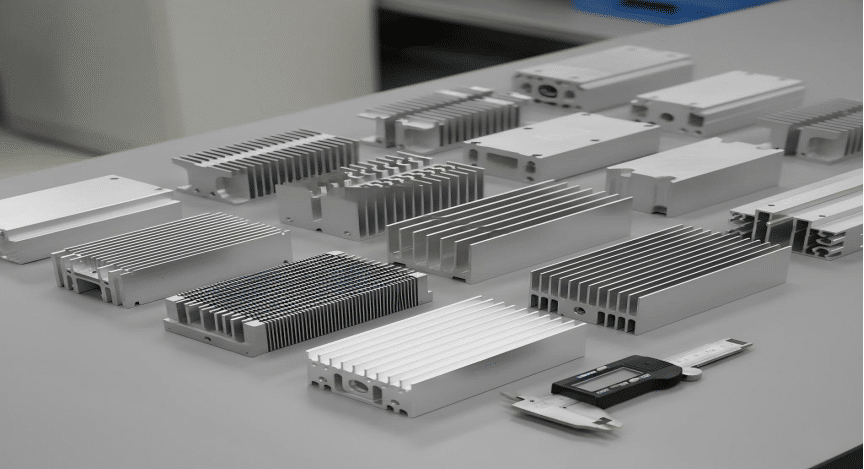
The most reliable, scalable, and cost-effective solution to this challenge remains the Aluminum Extruded Heat Sink**. However, selecting a heat sink is not as simple as picking a shape that fits inside your enclosure. It is a complex engineering equation involving fluid dynamics, material science, and surface emissivity thermodynamics. In this comprehensive guide, the Anrele Engineering Team breaks down the physics behind our profiles, helping you verify your thermal calculations and choose the perfect extrusion for your load.
1. Material Science: The Battle of Alloys (6063 vs. 6061 vs. Copper)
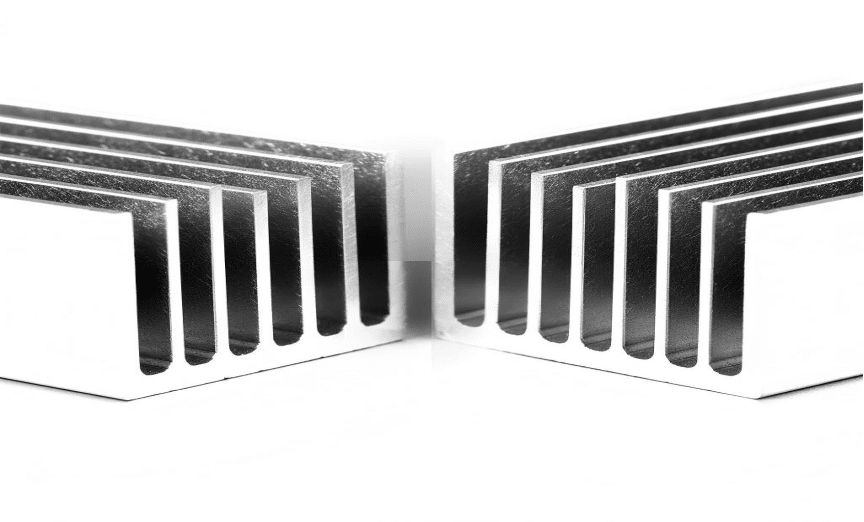
The first decision in any thermal management project is material selection. Why is Aluminum 6063-T5 the industry standard for extrusion? Why not use Copper? Why not use stronger aluminum?
The Conductivity Factor (k)
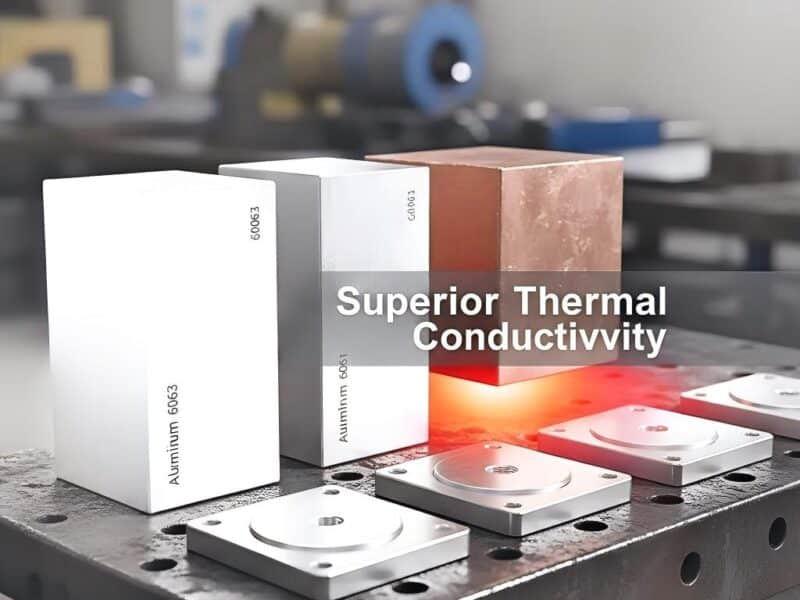
Thermal conductivity (denoted as ‘k’) measures a material’s ability to transfer heat energy through its crystal lattice. Copper is undeniably the thermal king, with a k-value of approximately 400 W/m·K. It conducts heat nearly twice as fast as aluminum. However, copper has significant downsides: it is heavy (density 8.96 g/cm³), expensive (often 4x the price of aluminum), and extremely difficult to extrude into complex, high-aspect-ratio fin shapes. Copper is typically reserved for skived fins in high-end CPU coolers or server applications.
This leaves Aluminum as the industrial champion. But not all aluminum is created equal. Many engineers confuse Structural Aluminum (6061) with Thermal Aluminum (6063).
• 6061 Alloy:** Contains higher amounts of Magnesium and Silicon. It is stronger and machines better, making it ideal for structural frames and brackets. However, these alloying elements interfere with the aluminum crystal lattice, lowering thermal conductivity to around 167 W/m·K.
• 6063 Alloy: This is the ‘Architectural’ or ‘Thermal’ alloy. It is softer and ‘purer.’ This purity allows for two critical advantages: First, it has a higher thermal conductivity (~200-209 W/m·K). Second, its flow characteristics during extrusion allow for much thinner, taller fins (High Aspect Ratio) than 6061, providing significantly more surface area for cooling.
Data Comparison: Thermal Conductivity & Properties
| Material | Thermal Conductivity (k) | Extrudability | Cost Factor | Typical Application |
| Pure Copper (C11000) | ~400 W/m·K | Very Low (Skiving only) | $$$$ | High-Performance Computing |
| Aluminum 6063-T5 | ~200-209 W/m·K | Excellent (High Fin Density) | $ | Anrele Standard Heat Sinks |
| Aluminum 6061-T6 | ~167-170 W/m·K | Good (Thick fins only) | $$ | Structural Brackets |
| Die Cast Al (A380) | ~100 W/m·K | Excellent (Complex shapes) | $$ | Motor Housings (Poor Thermal) |
2. Fin Geometry: The Physics of Airflow & Boundary Layers
Once the material is chosen, the geometry dictates performance. A heat sink works by increasing the surface area available for heat exchange with the air. However, simply adding more fins does not always result in better cooling. This is the ‘Aspect Ratio Trap.’
The Boundary Layer Problem
In fluid dynamics, as air flows over a solid surface (the fin), friction causes the air molecules closest to the surface to slow down. This creates a stagnant layer of air known as the Thermal Boundary Layer. Heat moves very slowly through stagnant air.
If you pack fins too closely together (High Fin Density), the boundary layers of two adjacent fins will overlap. When this happens, the space between the fins becomes ‘choked.’ Fresh, cool air cannot enter the gap to replace the hot air. The heat sink effectively becomes a solid block of hot aluminum, and thermal performance plummets.
Anrele Selection Rules
1. Natural Convection (Passive Cooling):** If you are not using a fan, the air velocity is driven solely by buoyancy (hot air rising). This force is very weak. To prevent choking, Anrele recommends **Wide Fin Spacing** (typically 6mm to 10mm). We prioritize Fin Spacing over Fin Count.
2. Forced Convection (Fan Cooled): If you use a fan, the static pressure pushes air through the boundary layer. In this scenario, we can use High Fin Density and Serrated Fins. The serrations (ridges on the fins) create turbulence, breaking up the boundary layer and improving heat transfer efficiency by 10-15%.
3. The “Base Thickness” Rule: Spreading Resistance
A common mistake in custom heat sink design is making the base plate too thin to save weight. Heat does not instantly appear on the fins. It enters at a small point source (the IGBT module or SSR base) and must travel laterally through the aluminum base to reach the fins at the edge of the profile.
This impedance to lateral heat flow is called Spreading Resistance. If the base is too thin, heat will concentrate directly under the heat source, creating a ‘Hot Spot.’ The fins directly under the chip will be very hot, while the fins at the edge of the profile will be cold and useless. Effectively, you are paying for a large heat sink but only using 50% of it.
Anrele Design Standard: For our large 200mm+ wide profiles, we maintain a base thickness of at least 10mm to 15mm. This ensures that the heat spreads evenly to the outermost fins, maximizing the total cooling capacity (Delta T) of the system.
4. Surface Treatment: Why Black Anodizing Matters
Customers often ask: ‘Does the color of the heat sink matter?’ The answer is rooted in the physics of Thermal Radiation.
Heat leaves a heat sink via two mechanisms: Convection (air movement) and Radiation (infrared emission). Bare, shiny aluminum has a very low Emissivity coefficient (ε ≈ 0.05). It acts like a mirror, reflecting heat back inside. Black Anodizing changes the surface structure, increasing emissivity to ε ≈ 0.85. This allows the heat sink to radiate heat energy effectively into the environment.
The Impact: In a passive cooling (natural convection) scenario, radiation can account for 15% to 20% of the total cooling. A black anodized heat sink can run 3°C to 5°C cooler than a bare aluminum one. In forced air systems, convection dominates, so the color matters less—but the anodizing still provides critical corrosion resistance.
5. Engineering Math: Calculating Thermal Resistance (Rth)
Engineers should not guess. You calculate. The performance of a heat sink is defined by its Thermal Resistance ($R_{th}$ or $R_{\theta}$), measured in °C/W.
The Formula:
$$T_j = P \times (R_{jc} + R_{cs} + R_{sa}) + T_a$$
Where:
• Tj: Max Junction Temperature of the chip (e.g., 125°C)
• Ta: Max Ambient Temperature inside the cabinet (e.g., 40°C)
• P: Power Dissipated (Watts)
• Rjc: Resistance Junction-to-Case (from chip datasheet)
• Rcs: Resistance Case-to-Sink (Thermal Grease interface, typically 0.1 °C/W)
• Rsa: Resistance Sink-to-Ambient (The Heat Sink spec)
Example Calculation:
You have a Solid State Relay generating 50 Watts of heat. You want to keep the base temperature below 80°C in a 40°C environment.
$$R_{th} Required = \frac{\Delta T}{Power} = \frac{80 – 40}{50} = \frac{40}{50} = 0.8 \, ^\circ C/W$$
Selection: You must select an Anrele heat sink profile with an Rsa rating of 0.8 °C/W or lower. If you choose a smaller profile with 2.0 °C/W, the SSR will overheat (140°C) and fail.
6. The Business Case: Extrusion vs. Machining
For prototype runs (1-10 units), CNC machining a heat sink from a solid block is faster. However, for production (100+ units), Extrusion is vastly superior in cost.
The Mold Cost Advantage: Opening a custom extrusion mold for aluminum is surprisingly affordable (often $500 – $1500 USD), compared to tens of thousands for plastic injection molds. Once the mold is made, the ‘Per Inch’ cost of the profile drops dramatically compared to machining time. At Anrele, we help customers transition from expensive CNC prototypes to efficient mass-produced extrusions, typically reducing unit costs by 60% to 80%.
7. Extended FAQ: Common Engineering Questions
Q1: Can I use thermal tape instead of thermal grease?
A: Thermal tape is convenient for low-power devices (memory chips), but it has high thermal resistance. For high-power applications (>10W) like SSRs or IGBTs, you must use high-performance Thermal Grease and screw mounting. The clamping force of the screw minimizes the interface thickness, ensuring maximum heat transfer.
Q2: What is the flatness tolerance of Anrele heat sinks?
A: Standard extrusion tolerance for flatness is typically 0.5mm per 100mm. However, for the mounting surface, Anrele performs a secondary CNC Face Milling operation to achieve a flatness of 0.05mm. This is critical to minimize the air gap between the component and the heat sink.
Q3: What is the maximum width you can extrude?
A: Our largest press allows for profiles up to 600mm wide in a single piece. For wider requirements (e.g., massive inverter backplanes), we use Friction Stir Welding (FSW) to join multiple profiles together seamlessly with zero loss in thermal conductivity.
Q4: How does altitude affect heat sink performance?
A: Air is less dense at high altitudes, which reduces its cooling capacity. As a rule of thumb, you should de-rate the heat sink performance by 10% for every 1000 meters above sea level.
Q5: Can you anodize in colors other than black?
A: Yes, we offer Clear (Silver), Blue, Red, and Gold anodizing. While Black offers the best emissivity, other colors provide the same corrosion protection and electrical insulation properties.
Q6: Do you offer custom cut lengths and drilling?
A: Yes. We are not just an extruder; we are a fabrication partner. We supply heat sinks cut to precise lengths, deburred, CNC drilled/tapped for your specific mounting pattern, and packaged ready for your assembly line.
Conclusion
A heat sink is not just a passive piece of metal; it is a critical component that defines the reliability and lifespan of your product. Choosing the right profile requires a holistic view balancing the Alloy (6063-T5), the Geometry (Fin Spacing), and the Surface Finish (Anodizing) against your specific thermal load.
At Anrele, we don’t just sell aluminum; we sell thermal assurance. Whether you need a massive comb profile for a solar inverter or a custom solution for an EV battery pack, our engineering team is ready to assist with calculations and simulations.
Ready to optimize your thermal management? Browse our catalog of Standard Aluminum Heat Sink Profiles or send us your STEP file for a custom thermal analysis.