

Introduction
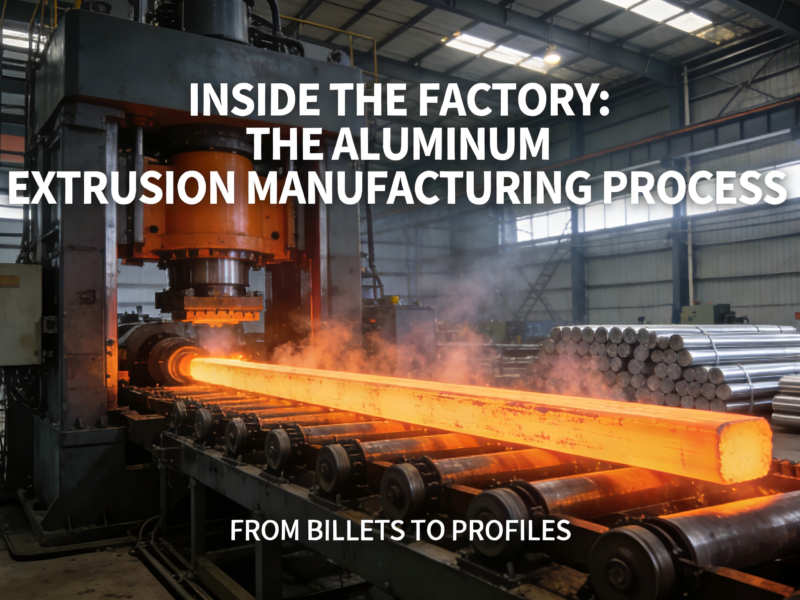
Industrial manufacturing requires immense physical energy continuously. Shaping solid metal demands absolute thermodynamic and kinetic control. Engineers transform rigid aluminum ingots into complex geometric profiles constantly. Understanding the complete aluminum extrusion manufacturing process provides critical sourcing intelligence immediately. Procurement officers must analyze these mechanical steps deeply to secure robust global supply chains. Ignorance regarding these metallurgical procedures invites catastrophic structural failures into your component inventory.
Many buyers assume extrusion simply involves pushing metal through a shaped hole. This oversimplification ignores the extreme atomic physics governing modern metal fabrication entirely. Generic factories frequently skip critical thermodynamic preparation steps to save operational costs. They extrude cold billets or ignore vital homogenization cycles entirely. These dangerous shortcuts produce brittle, highly stressed metal profiles. These inferior profiles fracture instantly under standard industrial mechanical loads.
You must demand absolute metallurgical perfection from your suppliers constantly. We operate advanced, vertically integrated foundries to guarantee this perfection. This technical guide deconstructs every single physical phase of metal shaping. We analyze precise alloy casting, intense hydraulic pressure physics, and essential post-extrusion heat treatments. We reveal exactly how our specialized facilities engineer flawless structural components for your global projects.
Aluminum Billet Casting and Homogenization
Flawless metal profiles begin long before the metal reaches the hydraulic press. The initial atomic composition dictates the ultimate structural strength entirely. We engineer the internal metallic lattice from the very first melting phase. We execute rigorous thermodynamic control during the entire casting procedure.
Melting Raw Aluminum Ingots
The process begins inside massive industrial reverberatory furnaces. Technicians load pure raw aluminum ingots into these superheated chambers. We raise the furnace temperature strictly above 700 degrees Celsius. The solid metal transforms into a glowing, highly volatile liquid pool rapidly. During this liquid phase, we deploy advanced rotary degassing units continuously. These units inject argon gas to strip harmful hydrogen bubbles out of the molten metal. We eliminate microscopic internal voids completely.
Alloying with Magnesium and Silicon
Pure aluminum lacks the necessary tensile strength for heavy industrial applications. We must engineer the atomic matrix by introducing specific elemental additives carefully. Technicians add precise percentages of magnesium and silicon into the molten pool. This specific chemical combination creates the highly robust 6000-series alloy family. The magnesium and silicon atoms bond to form magnesium-silicide compounds later during heat treatment. These microscopic compounds provide the extreme mechanical rigidity required for structural profiles.
Casting Cylindrical Billets
We must freeze this liquid alloy back into a solid, workable geometric shape. We execute advanced Direct Chill (DC) casting protocols to achieve this. The molten metal flows down into specialized vertical cylindrical molds continuously. High-pressure water jets blast the exterior mold walls simultaneously. The metal freezes rapidly into long, solid aluminum logs. These logs form the raw input material for the press. We have optimized our aluminum billet casting protocols to eliminate brittle intermetallic phases completely.
High-Pressure Extrusion Physics in Zhejiang
Furthermore, shaping solid metal logs requires unimaginable mechanical force continuously. Taizhou provides the massive electrical grid infrastructure necessary to run these operations. Consequently, we leverage local heavy industrial foundries daily without external delays. Therefore, we execute continuous high-tonnage pressing operations rapidly. Moreover, this centralized heavy industrial hub eliminates third-party logistical friction completely. Thus, we deliver pure structural reliability directly to your remote assembly plants.
Pre-Heating the Billets
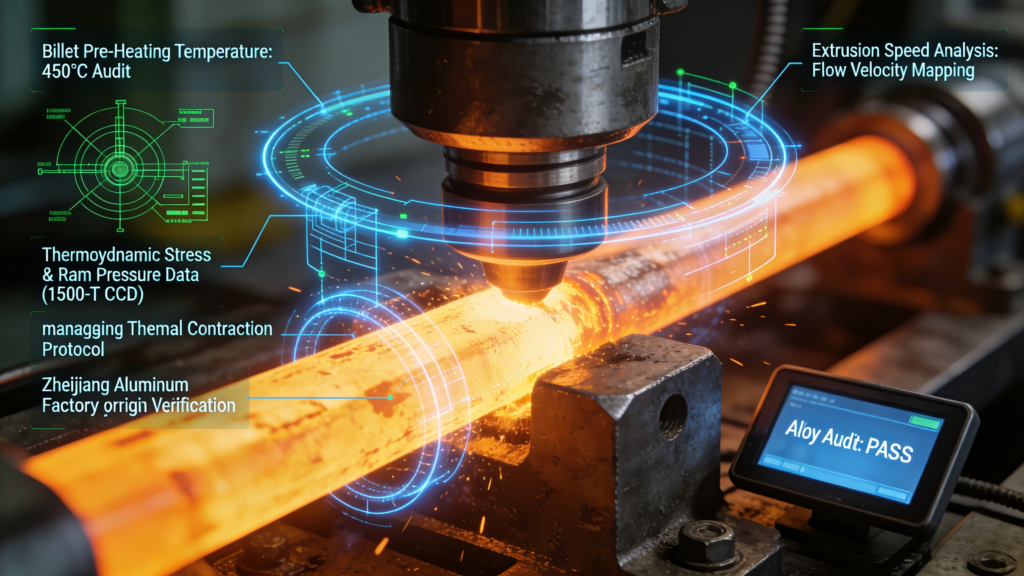
Furthermore, cold solid aluminum destroys steel extrusion dies instantly. Therefore, we must plasticize the metal before applying hydraulic pressure. Consequently, we load the solid aluminum billets into long induction heating furnaces. We elevate the billet temperature precisely between 450 and 500 degrees Celsius. Thus, the metal softens significantly without actually reaching its liquid melting point. Moreover, this precise thermal window ensures the metal flows perfectly through complex geometric die channels.
Applying Hydraulic Ram Pressure
Consequently, we load the heated billet into the thick steel container of the press. Therefore, a massive hydraulic ram drives forward with unimaginable kinetic force. Furthermore, this ram applies thousands of tons of direct compressive pressure onto the billet. Moreover, the aluminum expands outward, sealing tightly against the container walls immediately. Thus, extreme friction generates additional internal heat dynamically. We master this extreme extrusion press operation to prevent metallurgical tearing.
Forcing Metal Through the Steel Die
Moreover, the immense ram pressure leaves the metal only one escape route. Therefore, the plasticized aluminum forces its way through the intricate H13 steel die opening. Consequently, the metal assumes the exact cross-sectional geometry of the die perfectly. Thus, the continuous profile emerges from the press face at high velocity. Furthermore, our dedicated aluminum profile factory Taizhou monitors this exit temperature constantly. We guarantee the microstructural integrity remains flawless across the entire production run.
Comparison Matrix: Aluminum Extrusion Methodologies
Mechanical engineers evaluate friction variables, profile lengths, and machinery costs constantly. They analyze comparative fabrication data to optimize complex custom component designs. The following matrix contrasts core extrusion methodologies based on internal friction levels, output length capabilities, and capital machinery investment:
| Extrusion Methodology | Container Friction & Heat Generation | Profile Length & Geometric Capabilities | Capital Machinery Cost & Efficiency |
| Direct Extrusion (Forward) | Extremely High. The billet slides aggressively against the container wall during the entire stroke. This generates massive thermal friction. | Supreme. Capable of producing infinitely long, continuous structural profiles easily. The industry standard for 90% of architectural and industrial aluminum framing. | Moderate. The presses are incredibly common globally. Allows for rapid die changes and highly flexible, cost-effective OEM production runs. |
| Indirect Extrusion (Backward) | Very Low. The billet remains completely stationary inside the container. The die moves backward through the stationary metal. | Limited. The profile length is strictly limited by the length of the hollow ram stem. Cannot produce massive 6-meter structural beams efficiently. | High. Requires highly specialized, complex press machinery. Used primarily for specialized hard alloys that tear easily under high direct friction. |
| Impact Extrusion (Cold) | Moderate. The press strikes a cold aluminum slug with violent, instantaneous kinetic force. Operates at room temperature completely. | Very Short. Produces small, cup-like shapes exclusively. Cannot produce continuous linear profiles or hollow structural chambers. | Astronomical. Requires massive, high-speed mechanical stamping presses. Used exclusively for mass-producing identical small components like aerosol cans or battery casings. |
Cooling, Stretching, and Artificial Aging
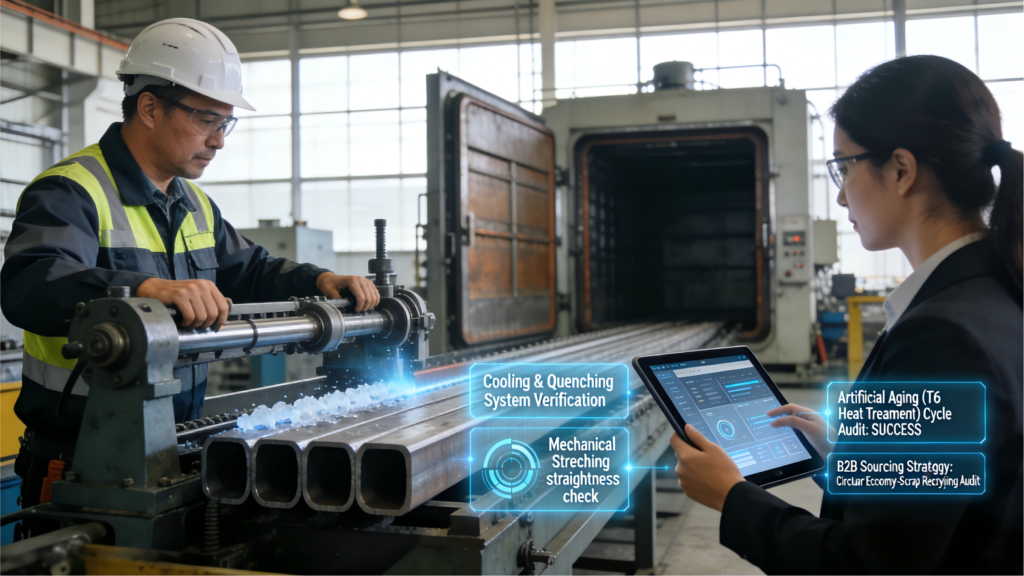
Executing a flawless structural component requires rigorous post-extrusion processing. The metal exits the press in a dangerously hot and highly malleable state. We must manipulate the internal crystalline structure to lock in mechanical strength. We engineer these specific cooling and stretching phases to guarantee absolute geometric stability. We eliminate internal metallurgical stresses across your entire component inventory.
Quenching the Hot Profiles
We must freeze the high-temperature atomic structure immediately upon exiting the press. We execute rapid quenching protocols directly on the run-out table. Depending on the specific alloy, we blast the profile with high-velocity air fans or heavy water sprays. This rapid temperature drop prevents the magnesium and silicon atoms from precipitating out prematurely. We trap these critical alloying elements in a supersaturated solid solution perfectly. This prepares the metal for future hardening.
Mechanical Stretching for Straightness
The rapid quenching process introduces severe thermal stresses into the long profile. The metal twists, warps, and bows noticeably as it cools unevenly. We utilize massive hydraulic gripping jaws at both ends of the run-out table. These jaws clamp the metal and pull it longitudinally with immense force. We stretch the profile roughly one to two percent past its elastic yield point. This mechanical stretching realigns the internal atomic grain boundaries perfectly. It relieves all internal thermal stress and straightens the profile absolutely.
Baking in Aging Ovens (T6 Temper)
Stretched profiles still lack their final ultimate tensile strength. We must execute a final thermodynamic phase to maximize mechanical rigidity. Technicians load the straight profiles into massive, climate-controlled aging ovens. We bake the metal at roughly 180 degrees Celsius for several continuous hours. This intense T6 heat treatment precipitates the trapped magnesium-silicide compounds evenly throughout the lattice. The aluminum hardens dramatically, transforming into a highly resilient structural component.
Frequently Asked Questions (FAQ)
1. How do you handle scrap metal and billet butts from the press?
We operate a highly efficient circular economy. The extrusion press leaves a small un-extruded piece of metal in the container called a ‘butt’. We sheer off these butts, collect all defective profiles, and remelt them directly in our factory foundry. We cast new billets with zero material waste, drastically lowering procurement costs.
2. What is isothermal extrusion and why is it critical?
Friction generates intense heat as the billet pushes through the die. If the exit temperature spikes too high, the metal surface tears and blisters. Isothermal extrusion utilizes specialized liquid nitrogen cooling on the steel die itself. This keeps the exit temperature perfectly constant regardless of the ram speed, ensuring a flawless surface finish.
3. How do engineers calculate thermal contraction after extrusion?
Aluminum expands significantly when heated to 500 degrees Celsius inside the press. As the profile cools to room temperature on the run-out table, it contracts physically. Our CAD engineers mathematically oversize the steel die opening by approximately 1% to 1.5%. We guarantee the final cold profile matches your exact dimensional tolerances perfectly.
4. Do you pre-heat the H13 steel extrusion dies as well?
Absolutely. Pushing a 500-degree aluminum billet into a cold steel die causes catastrophic thermal shock. The die would fracture instantly under hydraulic pressure. We pre-heat all steel dies in specialized ovens to match the billet temperature precisely. This ensures smooth material flow and drastically extends the operational lifespan of the custom tooling.
5. What is quench sensitivity in 6000-series alloys?
Quench sensitivity dictates how rapidly we must cool the profile to trap the alloying elements in a solid solution. 6061 alloy is highly quench-sensitive and requires an aggressive water bath immediately after the press. 6063 alloy is less sensitive and frequently achieves perfect structural integrity using high-velocity forced air cooling fans alone.
6. Why do some factories shroud the extrusion die in nitrogen gas?
Atmospheric oxygen reacts instantly with hot aluminum as it exits the press. This rapidly forms a thick, abrasive oxide layer that can drag against the die bearings, causing microscopic surface scratches. Injecting inert nitrogen gas around the die face displaces the oxygen entirely. This prevents premature oxidation and results in a mirror-like, ultra-smooth surface finish.
Conclusion
The mechanical reality within the global manufacturing market remains irrefutable constantly. Relying on fragmented supply chains operating substandard presses destroys your critical production schedules instantly. You must source your structural components from a highly verified custom aluminum extrusion factory. We engineer perfect thermodynamic profiles that guarantee absolute kinetic and structural reliability. By migrating your procurement to our facility, you acquire flawless geometric stability.
Partner with an elite industrial aluminum profiles manufacturer today to eliminate metallurgical defects forever. We deliver precision manufacturing directly from our high-tonnage foundries in Taizhou. Secure your bulk extrusion orders with our expert mechanical engineers. Upgrade your product chassis with premium, T6 hardened aluminum structures. Contact our aluminum extrusion service team and revolutionize your global B2B supply chain now.