Introduction
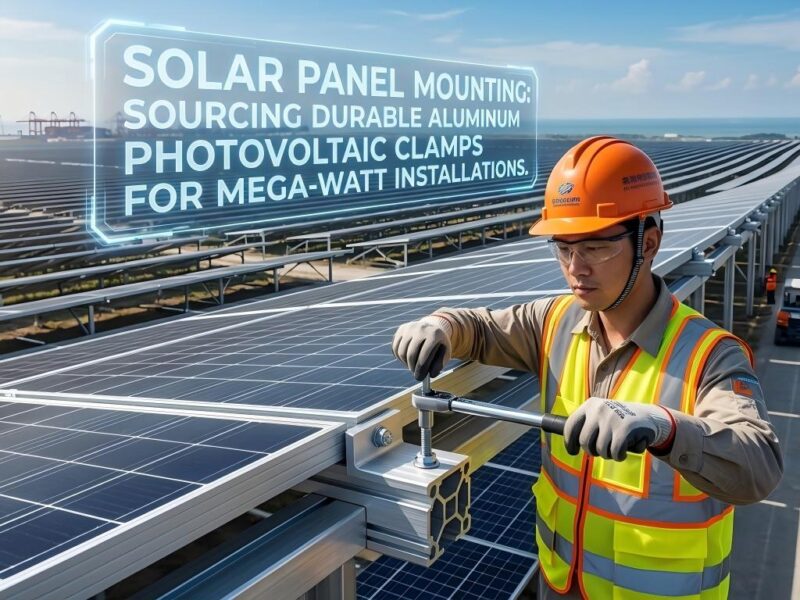
Global mega-watt solar farms expand aggressively across harsh geographical landscapes continuously. Procurement officers face immense pressure to secure reliable structural mounting components rapidly. Securing a precision-engineered aluminum photovoltaic clamp anchors your entire renewable energy infrastructure perfectly. Solar panels represent a massive financial investment for utility companies. If the mounting hardware fails during a severe storm, the expensive photovoltaic modules detach violently. They shatter across the landscape, destroying millions of dollars in capital investment instantly.
Generic hardware distributors completely underestimate the severe aerodynamic stresses affecting large solar arrays. They supply cheap, uncalibrated mounting brackets cast from inferior, porous metal alloys. These substandard clamps suffer from severe metallurgical fatigue under constant thermal expansion and contraction. Their weak threads strip instantly under pneumatic installation torque. This mechanical failure prevents secure panel clamping, leading to catastrophic module slippage during high wind events. You must eliminate this structural vulnerability entirely.
You must upgrade your utility-scale supply chain immediately. Partner directly with an elite Original Equipment Manufacturer (OEM) that executes advanced metallurgical processing. This technical guide deconstructs the exact physics of aerodynamic wind-load engineering. We analyze the critical T6 tempering process required for maximum tensile strength. We reveal how our advanced extrusion facilities guarantee absolute structural resilience for your demanding solar grid projects.
Wind-Load Engineering and Tensile Strength
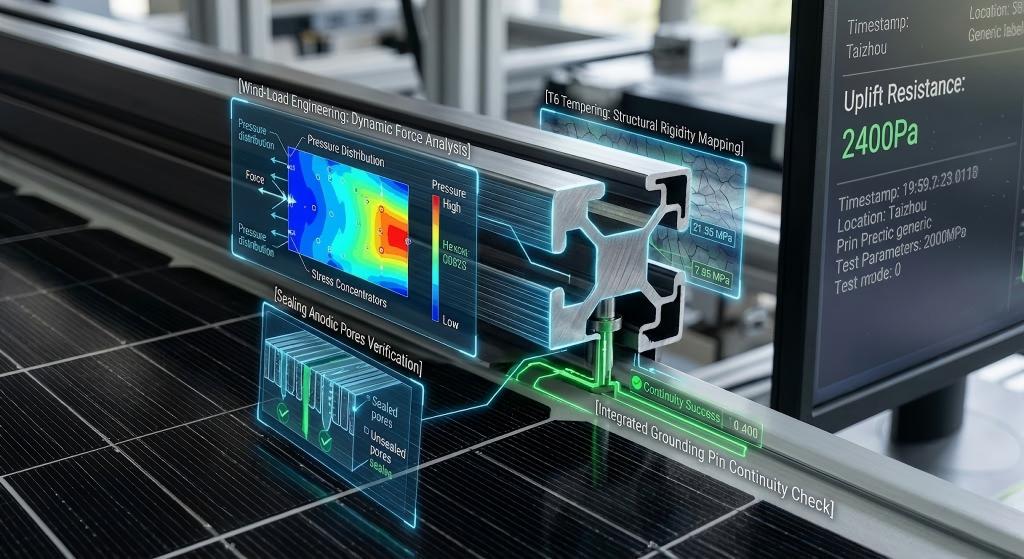
Solar arrays endure brutal aerodynamic forces constantly. Engineers must design mounting hardware to withstand extreme kinetic weather events. The metal clamp provides the sole mechanical anchor between the glass panel and the underlying steel substructure. We engineer these clamps to survive hurricane-force wind velocities without fracturing.
Calculating Dynamic Weather Forces
Wind flowing across a tilted solar panel creates severe aerodynamic uplift. The panel acts exactly like a massive airplane wing. Fast-moving air creates a severe low-pressure zone above the photovoltaic glass. High-pressure air underneath attempts to push the module forcefully upward. This dynamic uplift applies immense tensile stress directly onto the aluminum clamp. We calculate these precise aerodynamic uplift vectors using computational fluid dynamics. We design the clamp geometry to safely absorb and transfer this kinetic energy. You secure absolute structural stability during severe typhoon conditions.
T6 Tempering for Structural Rigidity
Raw extruded aluminum remains far too soft for structural mounting applications. Therefore, we execute rigorous T6 artificial aging protocols immediately after extrusion. We bake the aluminum profiles inside specialized industrial aging ovens. This intense heat treatment precipitates magnesium-silicide compounds throughout the metal matrix. This precipitation hardening drastically increases the ultimate tensile strength of the clamp. The hardened aluminum resists severe bending forces and prevents metal fatigue completely. We deliver a highly rigid solar panel mid clamp that never deforms under load.
Preventing Panel Slippage
Solar panels expand and contract continuously due to intense diurnal thermal cycling. This constant micromovement slowly loosens standard mounting hardware. We engineer our clamps with specialized serrated gripping teeth. These aggressive aluminum teeth bite firmly into the anodized frame of the solar module. They create a mathematically perfect high-friction interface. This secure mechanical bite prevents the heavy glass panel from sliding downward entirely. We guarantee your solar array maintains perfect geometric alignment for decades.
Rapid Solar Manufacturing in Taizhou
Furthermore, utility-scale solar farms require massive volumes of mounting hardware urgently. Taizhou provides this exact high-volume mechanical ecosystem perfectly. Consequently, we leverage local high-tonnage foundries daily. Therefore, we execute continuous metal production without delay. Moreover, this centralized hub eliminates third-party logistical friction completely. Thus, we deliver pure structural reliability directly to your remote solar installation sites.
Executing Continuous Extrusion
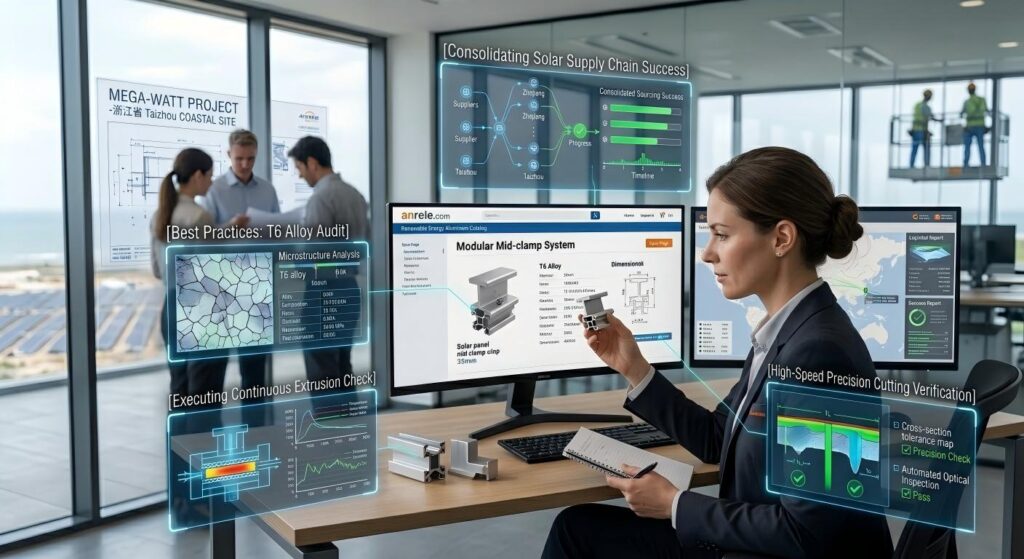
Furthermore, producing millions of clamps requires relentless manufacturing efficiency. Therefore, our Taizhou facility operates automated hydraulic extrusion presses continuously. Consequently, we push heated 6005-grade aluminum billets through hardened H13 steel dies rapidly. This continuous process generates thousands of meters of raw profile daily. Moreover, we maintain sub-millimeter dimensional accuracy across every single extrusion run. Thus, we provide the perfect raw material for the specialized end clamp extrusion required at the array edges.
High-Speed Precision Cutting
Consequently, raw extrusion profiles demand exact, high-speed secondary machining. Therefore, we operate massive arrays of automated CNC circular saws. We mass-cut the long aluminum profiles into individual 40mm or 50mm clamps instantly. Consequently, we ensure perfect 90-degree perpendicularity across every single cut. This extreme precision guarantees that the clamp sits perfectly flush against the solar panel frame. Moreover, a flush fit distributes the clamping pressure evenly, preventing localized stress fractures on the delicate solar glass.
Consolidating Solar Supply Chains
Moreover, managing fragmented supply chains delays critical renewable energy projects severely. We execute extrusion, cutting, punching, and anodizing entirely under one roof. Therefore, we eliminate the costly delays associated with transporting raw metal between third-party subcontractors. Consequently, we drastically compress your procurement lead times. Thus, we empower your engineering teams to hit strict utility-scale construction deadlines effortlessly. We are the premier provider of renewable energy aluminum China components.
Comparison Matrix: Solar Mounting Materials
Structural engineers evaluate tensile strength, environmental resistance, and weight constantly. They analyze comparative metallurgical data to optimize large-scale grid designs. The following matrix contrasts core mounting materials based on a 25-year lifespan, physical weight, and installation speed:
| Material Substrate | 25-Year Lifespan & Weather Resistance | Physical Weight & Roof Load Impact | Installation Speed & Modularity |
| Extruded Aluminum (6005-T6) | Supreme. Naturally forms a protective oxide layer. Anodizing extends the lifespan well beyond 25 years without degrading or rusting. | Extremely Lightweight. Crucial for commercial rooftop installations where structural dead-load limits restrict heavy metal framing. | Very Fast. Aluminum cuts and drills easily on-site. Custom extruded profiles interlock seamlessly with standard T-slot rails. |
| Hot-Dip Galvanized Steel | Moderate to High. The zinc coating prevents rust initially. However, drilling or cutting the steel on-site breaches the coating and invites rapid corrosion. | Extremely Heavy. Drastically increases the dead-load on rooftop installations. Slows down manual labor during vast ground-mount deployments. | Slow. Heavy components cause severe worker fatigue. Field modifications require intense grinding and cold-galvanizing spray touch-ups. |
| UV-Resistant Heavy Plastics | Poor. Intense ultra-violet radiation degrades long-chain polymers rapidly. Plastics become dangerously brittle after just 5 to 7 years of sun exposure. | Ultra Lightweight. Reduces shipping costs significantly but fails to provide the necessary sheer strength for high wind-load environments. | Fast. Components snap together easily. However, they lack the required mechanical grip to secure heavy 500W commercial solar panels safely. |
Anti-Corrosion and Anodizing for Outdoor Lifespans
Executing a flawless 25-year solar deployment requires advanced surface chemistry. Raw aluminum survives inland environments relatively well. However, coastal solar farms face brutal atmospheric salt degradation continuously. We process our terminal connectors through specialized electrochemical treatments to eliminate this corrosive threat. We engineer our clamps to outlast the photovoltaic panels entirely.
Surviving Severe Salt Spray Tests
Coastal environments assault metal infrastructure with highly corrosive, airborne sodium chloride. We deploy stringent Type II Anodizing protocols to protect our mounting hardware. The electrochemical acid bath forces oxygen into the aluminum substrate. It grows a highly dense, artificial aluminum oxide crystalline structure. We validate this protective armor through severe ASTM B117 salt spray testing. Our anodized clamps survive hundreds of hours inside concentrated saline fog chambers. They emerge completely free of destructive pitting or white rust corrosion.
Sealing Anodic Pores
The anodizing process creates microscopic, columnar pores within the new oxide layer. If left open, these pores trap caustic moisture and accelerate localized corrosion. Therefore, we execute a rigorous thermodynamic sealing process immediately. We submerge the anodized clamps into a boiling deionized water bath. This intense heat hydrates the aluminum oxide structure rapidly. The oxide swells and permanently seals the microscopic pores shut. We deliver a completely impenetrable, weatherproof aluminum solar mounting bracket for your projects.
Integrating Grounding Pins
Electrical safety demands continuous grounding across the entire solar array structure. The protective anodized layer acts as a severe electrical insulator. Therefore, standard flat clamps fail to ground the solar panel frame to the mounting rail. We solve this by integrating specialized stainless steel grounding pins into the clamp base. When technicians tighten the clamp bolt, these sharp pins pierce right through the anodized layer. They bite directly into the conductive aluminum core, establishing a permanent, code-compliant grounding path instantly.
Frequently Asked Questions (FAQ)
1. Can your mid clamps accommodate varying solar panel frame thicknesses?
Yes. Standard commercial solar panels feature frame thicknesses ranging from 30mm to 40mm. We engineer versatile, height-adjustable mid clamps utilizing extended stainless steel hex bolts and specialized sliding nut tracks. This modular design allows installers to secure different module brands seamlessly using the exact same clamp inventory.
2. Do you supply the necessary stainless steel mounting hardware with the clamps?
Absolutely. Supplying bare aluminum clamps without matching hardware frustrates field technicians. We provide fully assembled clamp kits including the extruded aluminum body, SUS304 stainless steel Allen bolts, spring washers, and sliding T-nuts. This kit approach drastically accelerates the installation velocity on the solar farm.
3. What is the standard surface finish thickness for your anodized clamps?
For standard inland solar farm deployments, we execute a highly durable 10-micron (AA10) clear anodized finish. For severe coastal, high-salinity, or highly industrial environments, we recommend upgrading to a thicker 15-micron (AA15) or 20-micron (AA20) anodized layer to guarantee a flawless 25-year operational lifespan.
4. How do you package heavy aluminum mounting hardware for international shipping?
We pack the assembled clamp kits into heavy-duty, double-wall corrugated cartons to prevent shifting. We then stack these cartons onto ISPM-15 certified wooden pallets and secure them with tight industrial shrink wrap and PET strapping. This rigid palletization prevents the heavy metal components from crushing each other during rough ocean transit.
5. Are there limits when shipping solar mounting hardware via LCL (Less than Container Load)?
While LCL is technically possible, dense metal hardware is extremely heavy. Shipping LCL exposes these precisely machined clamps to severe transit damage when consolidated with third-party heavy machinery inside the container. Executing a dedicated FCL (Full Container Load) mathematically secures the cargo geometry and drastically reduces the landed freight cost per unit.
6. Can you extrude custom rail profiles to match our proprietary mounting system?
Yes. We operate as a primary OEM aluminum factory. You can submit your proprietary DXF or DWG engineering files securely to our metallurgical team. We will cut a bespoke H13 steel extrusion die dedicated entirely to your specific solar rail and clamping geometry.
Conclusion
The mechanical reality within the global renewable energy market remains irrefutable. Failing structural mounting systems destroy critical solar infrastructure instantly. You must source your structural extrusion components from a highly verified custom aluminum extrusion factory. We engineer perfect mounting profiles that guarantee absolute kinetic and structural reliability against severe weather. By migrating your procurement to our facility, you acquire flawless clamping geometry.
Partner with an elite industrial aluminum profiles manufacturer today to eliminate aerodynamic failures forever. We deliver precision manufacturing directly from our high-tonnage foundries in Taizhou. Secure your bulk extrusion orders with our expert renewable energy engineers. Upgrade your mega-watt solar farms with premium, deeply anodized mounting clamps. Contact our aluminum extrusion service and revolutionize your global grid supply chain now.