

Introduction: Mitigating Risk in the Global Supply Chain
Securing a reliable supply chain is the most critical operational challenge facing modern engineering and procurement directors. When scaling up production for heavy-duty machinery or sensitive electronic components, partnering with a verified, top-tier industrial aluminum profile manufacturer represents a strategic baseline for success. The global market is saturated with middle-men, trading companies, and sub-standard foundries that over-promise and consistently under-deliver on mechanical tolerances. Consequently, selecting the wrong partner inevitably leads to catastrophic assembly line delays, structural part failures, and massive financial liabilities.
To navigate this complex industrial landscape, procurement teams must look far beyond basic unit pricing. They must meticulously audit the underlying material science, production capacity, and secondary CNC machining capabilities of the prospective factory. A true primary manufacturer controls the entire lifecycle of the metal—from smelting raw aluminum ingots to the final multi-axis CNC surface milling.
Therefore, establishing rigorous evaluation criteria is an absolute necessity for protecting your enterprise’s operational integrity. In this comprehensive B2B sourcing guide, we will dissect the complex metallurgy of the extrusion process, outline exactly how to distinguish a fully integrated ISO certified aluminum factory from a mere trading firm, and explore the advanced manufacturing capabilities that define an elite global supplier.
Core Advantages & The Physics of Aluminum Extrusion
To effectively evaluate an aluminum extrusion supplier, a procurement manager must possess a fundamental understanding of the metallurgical and mechanical physics driving the extrusion process. The quality of the final profile is permanently dictated by the precise control of thermal and kinetic energy inside the factory.
Billet Purity and Extrusion Tonnage
The manufacturing process begins with the raw aluminum billet. High-end factories strictly utilize A00 grade primary aluminum ingots to cast their billets, ensuring absolute chemical purity. If a manufacturer relies heavily on recycled scrap aluminum without strict spectrometer testing, the resulting alloy will contain severe impurities that degrade the metal’s ultimate tensile strength.
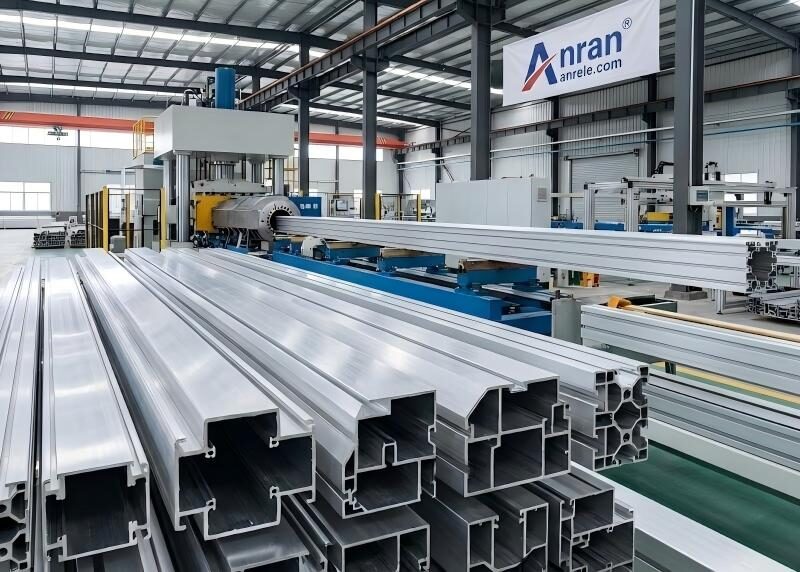
Furthermore, the mechanical force of the extrusion press dictates the complexity of the profiles it can produce. The press utilizes a massive hydraulic ram to push the heated aluminum billet (plasticized at approximately 450°C to 500°C) through a hardened H13 tool steel die. Elite manufacturers operate a wide fleet of presses ranging from 600-ton machines for delicate heat sinks up to massive 3,000-ton (or higher) presses for heavy architectural structural beams. Evaluating a factory’s press tonnage capabilities reveals exactly what size and density of profiles they can physically manufacture.
Thermodynamic Quenching and Tempering (T5/T6)
Once the profile exits the extrusion die, it must undergo rapid thermodynamic cooling, known as quenching. The speed at which the aluminum cools fundamentally alters its internal crystalline grain structure. For standard 6063 alloys, forced air cooling on the run-out table achieves the T5 temper. However, for high-strength 6061 alloys used in critical load-bearing applications, the factory must utilize rapid water quenching. Following the quench, the manufacturer moves the profiles into massive thermal aging ovens. This artificial aging precipitates magnesium silicide particles within the metal matrix, drastically increasing the yield strength and hardness. An elite custom aluminum extrusion China partner utilizes tightly calibrated, uniform-temperature ovens to guarantee that a 6-meter profile possesses the exact same Rockwell Hardness (HRB) at both ends without any weak zones.
Key Applications in Modern Industry
When a manufacturer completely masters the physics of extrusion and metallurgy, the resulting profiles serve as the critical structural backbone for the most demanding industrial sectors globally.
Electric Vehicle (EV) Battery Housings
The automotive industry is undergoing a massive paradigm shift toward electrification. The lithium-ion battery packs sitting at the floor of an EV are incredibly heavy and highly volatile. Engineers require enclosures that provide extreme structural crash resistance while simultaneously acting as massive thermal heat sinks to cool the battery cells. High-strength extruded aluminum profiles provide the exact solution. Top-tier manufacturers extrude complex, multi-chambered profiles that circulate liquid coolant directly through the structural walls of the battery tray, successfully merging mechanical safety with advanced fluid dynamics.
Automation Robotics and T-Slot Framing
In the realm of factory automation, machine builders require modularity and absolute rigidity. Therefore, they universally rely on precision-extruded T-slot aluminum profiles to construct robotic gantries, machine guards, and conveyor chassis. Because these structures support heavy, rapidly moving servo motors, the dimensional tolerance of the T-slot must be flawless. If a substandard manufacturer supplies warped profiles or inaccurate slot dimensions, the entire robotic assembly will suffer from dangerous vibrational resonance and structural misalignment.
Aerospace and High-Speed Rail Transport
Every gram of weight added to an aircraft or a high-speed train exponentially increases its lifetime fuel consumption. Consequently, aerospace and rail engineers obsessively pursue weight reduction. By collaborating with advanced OEM aluminum parts manufacturers, transport designers replace heavy steel chassis components with highly engineered, thin-walled aluminum extrusions. These specific profiles undergo rigorous ultrasonic non-destructive testing (NDT) at the factory to guarantee zero internal micro-fractures, ensuring absolute passenger safety at extreme velocities.
Comparison Table: Aluminum vs. Traditional Industrial Materials
When procuring raw materials for industrial applications, purchasing directors often weigh aluminum extrusions against traditional substrates. The following table objectively contrasts custom aluminum profiles against Carbon Steel and Engineering Plastics across critical B2B manufacturing metrics.
| Performance Metric | Custom Extruded Aluminum | Carbon Steel / Iron | Engineering Plastics |
| Tooling / Die Cost | Very Low (Affordable) | High (Stamping dies are expensive) | Extreme (Injection molds are costly) |
| Tooling Lead Time | Extremely Fast (10-15 Days) | Slow (4 to 8 Weeks) | Very Slow (8 to 12 Weeks) |
| Strength-to-Weight | Exceptional (High yield, low mass) | Poor (High strength, massive dead weight) | Good (Lightweight, low rigidity) |
| Cross-Section Complexity | Limitless (Intricate internal cavities) | Limited (Cannot create hollows easily) | High (Limited by sink marks) |
| Corrosion Resistance | Excellent (Naturally passivates) | Poor (Requires continuous coating) | Excellent (Immune to rust) |
As the economic and mechanical data clearly demonstrates, aluminum extrusion offers an unparalleled advantage in rapid prototyping and low tooling costs. Unlike plastic injection molding or steel casting, which require massive upfront capital expenditures, an elite extrusion die design facility can iterate complex custom profiles rapidly, allowing engineering teams to bring products to market faster and with significantly less financial risk.
Customization and CNC Machining Capabilities
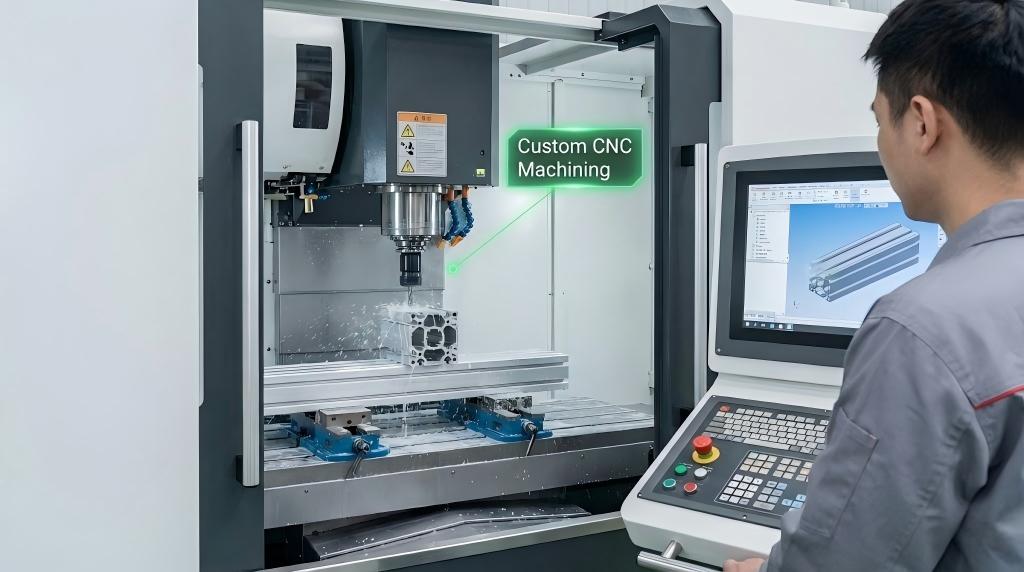
Procuring the raw linear extrusion is merely the first half of the supply chain equation. Industrial applications rarely utilize raw 6-meter sticks of metal. The profiles must be cut, drilled, tapped, and milled into highly specific, ready-to-assemble components. Evaluating a factory’s in-house CNC capabilities is the ultimate litmus test for a reliable manufacturing partner.
Vertical Integration of Multi-Axis CNC Milling
If an extrusion factory must outsource its machining to a third-party machine shop, the supply chain immediately fractures. Outsourcing introduces severe quality control gaps, extended lead times, and finger-pointing when dimensional errors occur. Conversely, a fully integrated facility like Anran Electric operates vast internal floors dedicated to 3-axis, 4-axis, and 5-axis CNC machining centers. This vertical integration allows engineers to hold extreme micro-tolerances (e.g., ISO 2768-m) across complex geometries, guaranteeing that every single part fits your assembly line flawlessly.
Surface Finishing and Anodizing Control
Industrial environments subject components to severe chemical and atmospheric abuse. Therefore, the aluminum must receive protective surface treatments. A premium manufacturer operates its own anodizing lines. By controlling the electrochemical anodizing process internally, the factory dictates the exact microscopic thickness of the aluminum oxide layer. Whether the specification calls for a standard 10-micron decorative clear coat or a rugged 50-micron Type III hardcoat for abrasive environments, in-house chemical processing guarantees batch-to-batch color consistency and absolute corrosion immunity.
Stringent Metrology and Quality Assurance
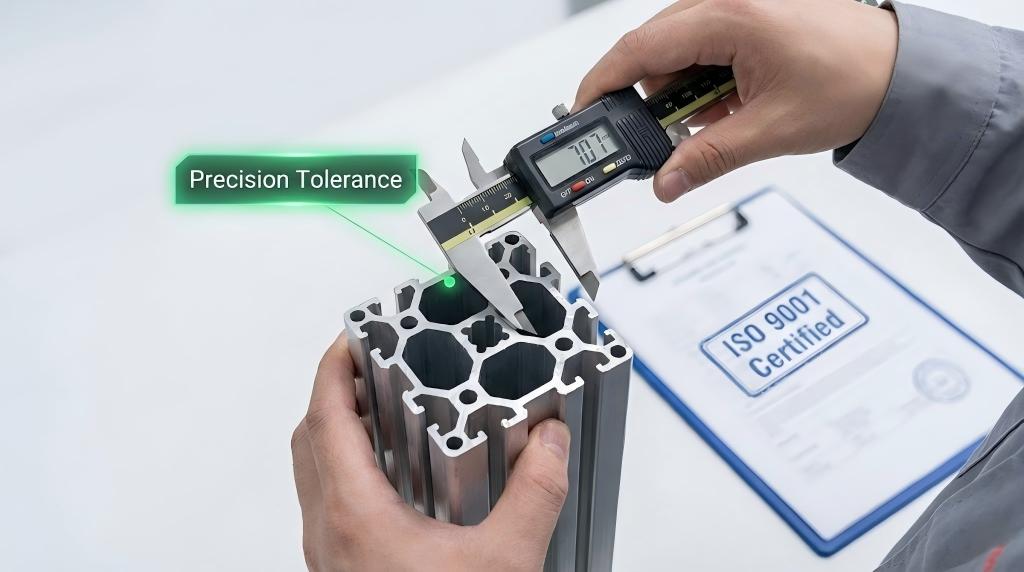
Ultimately, CNC capabilities mean nothing without rigorous metrology. Top-tier manufacturers do not rely on basic hand calipers. Instead, they utilize Coordinate Measuring Machines (CMM) and optical profile projectors to verify complex geometries against the client’s original 3D CAD files. They compile comprehensive First Article Inspection (FAI) reports and Material Test Reports (MTR), providing procurement managers with irrefutable, data-driven proof of compliance before authoring mass production.
FAQ: 6 Highly Specific Sourcing Questions Answered
1. How do I verify if a Chinese supplier is a true factory or just a trading company?
Request a live video tour of the factory floor during operational hours, specifically asking to see the extrusion presses, the billet heating furnaces, and the CNC machining centers. Furthermore, request their ISO 9001 certification and verify that the registered company address matches the physical factory production location.
2. What ISO certifications should a reliable aluminum extrusion supplier hold?
At a minimum, the manufacturer must hold ISO 9001 (Quality Management Systems). For environmental compliance, look for ISO 14001. If you are sourcing components for the automotive sector, the supplier must strictly hold the highly demanding IATF 16949 certification, which guarantees rigorous defect prevention in the supply chain.
3. How long does it take to design, cut, and test a custom extrusion die?
For standard solid profiles or simple hollows, a proficient tool and die shop can design, CNC wire-cut the H13 steel die, heat treat it, and push the first T0 (first trial) physical sample within 10 to 15 business days. Highly complex, multi-cavity dies may take up to 20 days.
4. What is the standard Minimum Order Quantity (MOQ) for custom profiles?
Because setting up an extrusion press requires pre-heating heavy steel dies and loading massive aluminum billets, factories cannot efficiently run extremely small batches. The standard industrial MOQ for a custom profile typically ranges from 500 kg to 1,000 kg per run, depending on the specific weight-per-meter of the profile.
5. How do Chinese manufacturers handle intellectual property (IP) protection for OEM parts?
Reputable, established manufacturers understand that IP protection is paramount to long-term international relationships. They will readily sign comprehensive Non-Disclosure Agreements (NDAs) and NNN (Non-Disclosure, Non-Use, Non-Circumvention) agreements enforceable under Chinese law, guaranteeing that your proprietary CAD designs are never shared or sold to third parties.
6. What quality control testing should I expect before international shipment?
A top-tier factory will provide a comprehensive document package with every shipment. This includes a Mill Test Certificate (MTR) proving the exact chemical composition of the alloy, Rockwell/Webster hardness test data proving the T5/T6 temper, and a detailed dimensional inspection report utilizing CMM data to verify the CNC tolerances.
Conclusion: Partnering for Global Success
Building a resilient, high-performance product requires an equally resilient supply chain. By rejecting opaque trading companies and partnering directly with a vertically integrated factory, procurement teams eliminate hidden markups, accelerate their time-to-market, and secure absolute control over the quality of their critical components.
Do not allow sub-standard metallurgy or sloppy machining to jeopardize your engineering reputation. Transition to a strictly audited, data-driven manufacturing partner capable of executing your most demanding architectural and mechanical visions. Explore our massive extrusion capacities and CNC capabilities by visiting the industrial aluminum profile manufacturer hub at Anran Electric, and secure a quote for your next OEM project today.