
Introduction: Bridging the Gap Between Design and Reality
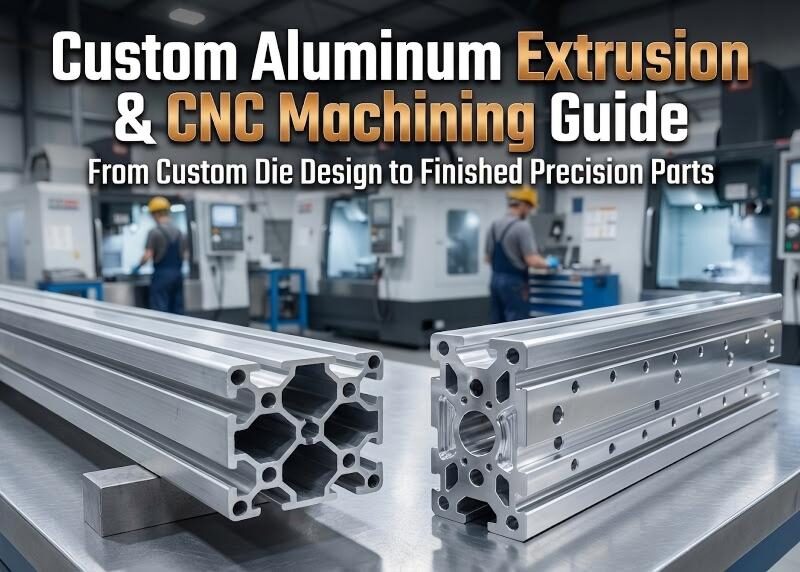
In the world of industrial design, off-the-shelf components are convenient, but they rarely offer the perfect fit for high-performance machinery. When a standard T-slot profile cannot handle the load, or a generic heat sink fails to dissipate enough thermal energy, engineers turn to custom aluminum extrusion.
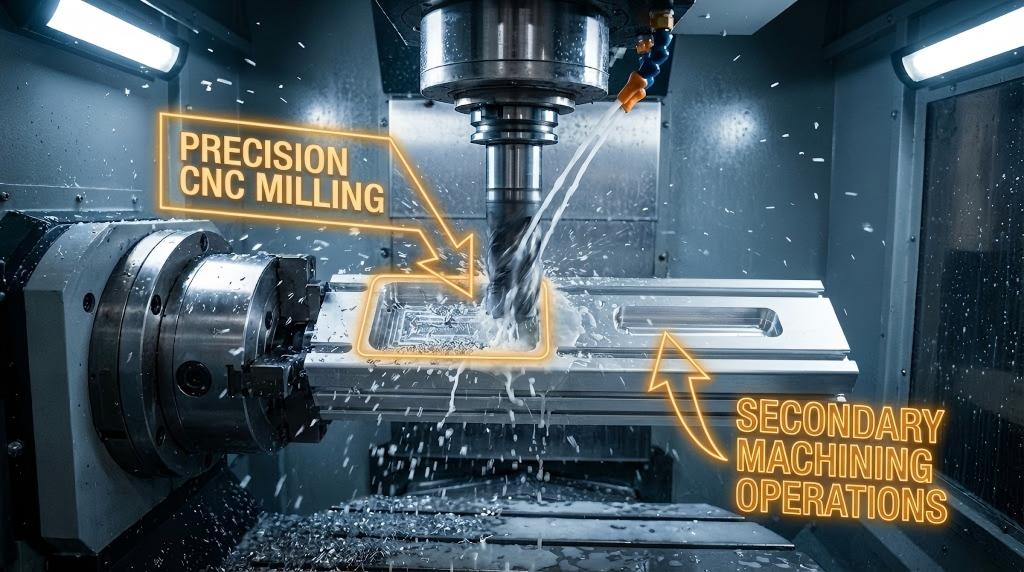
Custom extrusion is the process of creating a specific cross-sectional profile by forcing heated aluminum alloy through a specially designed steel die. However, extrusion is often just the first step. To transform a raw profile into a functional component—like a pneumatic cylinder body or a hydraulic manifold—it requires secondary operations: precision CNC machining, drilling, tapping, and surface finishing.
This guide demystifies the OEM manufacturing process at Anrele. We will explore the economics of tooling (die creation), the precision of CNC milling, and the material science that helps you choose between 6063 and 6061 alloys. Whether you are scaling up from a prototype or looking to optimize an existing part, our manufacturing services provide the solution.
The OEM Process: Designing a Die for Custom Aluminum Extrusion
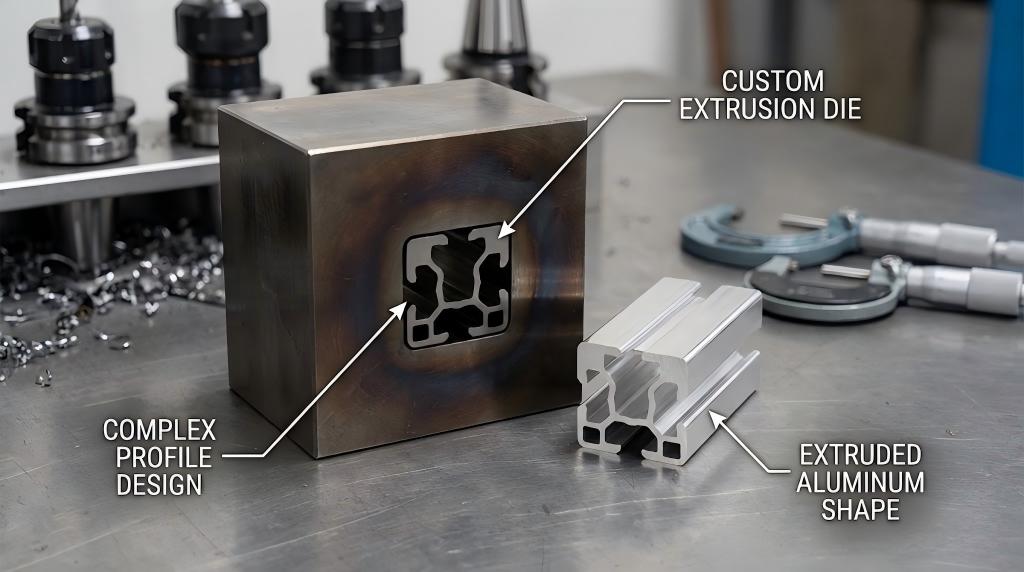
The journey of a custom part begins with the Die (Mold). This is the negative shape of your desired profile cut into H13 tool steel.
Step 1: DFM Analysis (Design for Manufacturability)
Before we cut steel, our engineers analyze your CAD drawing. We look for ‘choke points’—areas where the wall thickness transitions too abruptly from thick to thin. Uniform wall thickness is key to preventing warping during the cooling process. We often suggest adding small radii (fillets) to sharp corners to improve material flow and die life.
Step 2: Extrusion Ratios
We calculate the ‘Extrusion Ratio’—the cross-sectional area of the billet divided by the area of the profile. A ratio that is too high (>50:1) requires immense pressure and slows down production. A ratio that is too low (<10:1) may not work the metal enough to achieve the desired grain structure.
Step 3: Trial Mode (T1 Sample)
Once the die is made (typically 10-15 days), we run a ‘T1’ sample. This raw extrusion is checked for dimensional accuracy before we proceed to mass production and hardening (T5/T6 tempering).
CNC Machining and Tolerance Control (ISO 2768-m)
Extrusion gets you the shape; CNC machining gets you the precision. While extrusion tolerances are generally ±0.5mm, many applications, such as our pneumatic cylinder tubes, require much tighter control.aluminum heat sinks where surface flatness determines thermal transfer efficiency.
From Linear to 3D
After the profile is extruded and cut to length, it enters our CNC machining center. Here, we perform:
• 5-Axis Milling: For complex features on multiple faces without re-fixturing.
• Precision Drilling & Tapping: Adding threaded holes for assembly.
• Surface Facing: Milling the ends perfectly flat and perpendicular to the axis.
Meeting ISO 2768-m
We adhere to the ISO 2768-m (Medium) standard for general machining tolerances. For critical features (like bearing bores or seal surfaces), we can hold tolerances as tight as ±0.01mm. This level of precision is critical for components like
Common Aluminum Alloys Used (6063, 6061, 6005)
Selecting the right alloy is a trade-off between strength, surface finish, and cost.
| Alloy | Characteristics | Best Application |
| 6063-T5 | Excellent surface finish, easy to extrude, good corrosion resistance. | Architectural trim, Heat sinks, Pneumatic cylinders. |
| 6061-T6 | High structural strength, good machinability, harder than 6063. | Structural frames, Automotive parts, High-pressure manifolds. |
| 6005-T6 | Intermediate strength, similar to 6061 but easier to extrude. | Solar mounting rails, Bus/Train profiles. |
Design for Manufacturability (DFM) Tips for Extrusion
To reduce tooling costs and improve yield, keep these tips in mind when designing your custom profiles:
1. Avoid Deep, Narrow Channels
A deep, narrow slot in a profile requires a thin, fragile steel tongue in the die. These tongues break easily. Try to keep the depth-to-width ratio of any slot under 3:1.
2. Minimize Hollows
Hollow profiles (like tubes) require a ‘porthole’ die, which is more expensive and leaves faint weld lines on the profile surface. If a U-shape can function instead of a square tube, it will be cheaper to produce.
3. Wall Thickness Balance
Try to maintain a consistent wall thickness throughout the profile. Varying thickness causes the aluminum to cool at different rates, leading to bowing or twisting.
OEM and Custom Project Considerations
Moving from a design to a shipped product involves logistics.
• Intellectual Property (IP): Anrele signs Non-Disclosure Agreements (NDAs) for all OEM projects. Your die design remains your exclusive property.
• MOQ (Minimum Order Quantity): While we can extrude small batches (e.g., 500kg), the unit cost decreases significantly at 1-2 tons due to setup times.
• Packaging: Custom parts often require custom protection. We offer interleaving paper, shrink wrap, and wooden crates to prevent scratches during ocean transit. Learn more about our logistics on our Contact Page.
Conclusion: Your Partner in Precision Manufacturing
Custom aluminum extrusion is a powerful tool for product differentiation. It allows you to integrate multiple functions—structural, thermal, and aesthetic—into a single component, reducing assembly time and part count.
At Anrele, we combine large-tonnage extrusion presses with precision CNC machining to offer a true one-stop solution. Whether you need a massive structural beam or a tiny electrical terminal connector, we have the expertise to deliver. Get a quote today and let’s bring your design to life.
For more details on our company history, visit About Anrele.
FAQ: Common Technical Questions
1. When should extrusion be used instead of machining?
Extrusion is ideal for parts with a constant cross-section (like rails, tubes, or heatsinks). It is far more material-efficient than machining from a solid block. Machining is better for low-volume, complex 3D shapes that vary along the length.
2. What tolerances are achievable with CNC aluminum parts?
For general dimensions, we follow ISO 2768-m (±0.1mm to ±0.3mm depending on size). For precision features like bearing pockets, we can achieve ±0.01mm.
3. What is the Minimum Order Quantity (MOQ) for custom dies?
Typically, the MOQ for a custom extrusion run is 500kg. However, for the initial trial (T1 sample), we produce just a few meters for your approval.
4. How much does a custom extrusion mold cost?
It depends on the size and complexity (solid vs. hollow). A small solid die might cost $300-$500, while a large, complex hollow die could cost $1,500+. This is a one-time fee.
5. Can you machine features that cannot be extruded?
Yes. This is our specialty. We extrude the base profile and then CNC machine features like side holes, pockets, threads, and chamfers that are impossible to create via extrusion alone.
6. What is the lead time for a sample profile?
Die creation takes 10-15 days. Trial extrusion takes 2-3 days. So, typically you can expect samples within 2-3 weeks from drawing approval.